Showing posts with label meaning of death. Show all posts

21 August 2010

This could save your life

Just a thought, use it, don't use it.


The age of consent chart from Wikipedia. Absolutely crucial information for any traveller. Don't forget your towel either.

17 July 2010

Respect the dead

WARNING: This post is about Death and entirely inappropriate. But you must be used to that by now.

Death Index chart

The Chart of the Day death index from Business Insider. It shows the best spot for your final meeting with the Grim Reaper.

Why must we respect the dead?


In most cultures, it is bad luck to speak ill of the dead. When someone dies, everyone has to pretend to be upset, whether you are or not. Even if the person was a complete dud of a human being like Manto Tshabalala-Msimang, who caused the suffering and death of many, we must pay respect and pretend that it's a sad event that this person passed away.

The only notable exception to this rule seems to be the Adolf Hitler biography. In that case, it was perfectly acceptable not to be upset but to call the spade a fucking shovel. His biography didn't change when he shoved off.

The dead cannot do anything to you


Unlike in films like the Poltergeist and Drag Me to Hell, the dead cannot do anything to you. They are not going to do unsolicited interior decorating while you are trying to sleep. They are not going to take your place in the queue at the supermarket. You're clear on this one.

It's too late for them to change


If he died an asshole, he's a dead asshole. He's not suddenly a dead saint. You can find any number of Kurt Cobain creeps out there who also know 4 chords and who also sound like they're chewing on their own gallbladder. Yet Kurt Cobain had the common courtesy to remove himself from the gene pool, so his songs are genius while the others who sound exactly the same are commercial or uninspired, regardless of when they started writing their camp fire classics with distortion songbook.

It's too late to bury the hatchett


If you had a grudge against them and they died, it's too late. It's pointless to be concerned over how they felt about your feud when they died, because they're dead. Maybe you want to pay respect now to ease your conscience. That's all good and well, but it doesn't change anything.

You can't do x because someone died


The most bizarre aspect of this sudden sainthood that death brings is that we, the living, are not allowed to be happy or to partake in any debauchery for an unspecified amount of time. Why? Out of respect for a bag of bones. Out of respect for slowly decaying flesh that's only different from the same you find in a butchery by virtue of the fact that it did more than respond to its name by sometimes using yours back at you.

When someone close to me dies, that's exactly when I need debauchery to cheer me up the most.

If that's how you feel, people won't respect you when you're dead


I don't need respect when I'm dead. I'm dead. In fact, let it be known that I would not want any kind of religious boredom or default metaphysical posthumous vibes towards me at my funeral whatsoever. I'd like my funeral to be a bring en braai with headbanging strippers and an open bar. The first person to get arrested would inherit my estate, but only if they do not respect me all of a sudden because I'm pushing daisies.

24 May 2009

Human by Death review

Last year, I had a Month of Megadeth during May. May is my birthday month so I like to do something special. Something so special that I won't forget it during the inevitable bouts of drinking and debauchery. This year, I'm having a Death Month.

Conclusion


Chuck Schuldiner basically hires Cynic as his backing band and together they craft one of the most skin tearing albums of all time.

Death Human album cover

Review


The album opens with Sean Reinert's incredible drumming fading in. From there, the riffs exchanged between Chuck and Paul Masvidal are tighter than the fix Government Motors (er, General Motors) finds itself in. Widely regarded as Death's finest moment, I prefer Symbolic but Human is certainly just as flawless.

The lyrics are introspective to the point of becoming existential. They deal with euthanasia, masks people wear to project a desired, distorted image to the world and simply with being human. This prompts some questions about what it means to be human. Are we human because we do human things, or are we human because we are born this way? Alan Turing and John Searle are two bright minds who have answered this question in different ways.

The Turing Test


Alan Turing described his Turing test in his paper Computing Machinery and Intelligence.

The Turing test involved three participants: two humans and one computer. One human and one computer are locked in separate rooms. The remaining human poses questions to the inhabitants of each room by typing them into a terminal. The purpose of these questions is to find out which room hosts the human and which the machine. Turing suggests that when the computer can fool the player to think that its room hosts a human, the computer would have passed the Turing test.

The Turing test from Wikipedia

Turing seems to suggest that we are human because we do human things. Thus, if a computer were to do the same human things and can fool us into believing it is human, it would be as good as human. Basically, computers would be human when we say they are human and we can decide when and how they are to become human. Thus, computers would become human because Stone Cold says so.

Stone Cold Steve Austin

Stone Cold Steve Austin. According to Turing, computers become human when Stone Cold says so.

This avoids the issue a little - something that Turing no doubt knew, but he probably avoided the issue in this way for the practical purposes of building imitation humans. Philosopher John Searle is not happy with this arrangement.

Searle's Chinese Room


John Searle presents his Chinese Room argument in his paper Minds, Brains, and Programs. Searle proposes a scenario whereby artificial intelligence has evolved to the point where one such system can be taught fluent Chinese. The system is hosted inside a room and comfortably passes the Turing test by conversing with a human Chinese speaker outside the room.

According to Searle, the machine merely did symbol manipulating according to algorithms. Some proponents of strong AI would reason that the computer passed the Turing test as it understands Chinese. However, Searle turns the experiment around by suggesting that he himself is in a room with all the tools he would need to translate Chinese - dictionaries, pencils, paper, etc. He would be able to translate any Chinese characters which came through the door without understanding a world of Chinese. Searle argues that since he clearly does not understand a word of Chinese, yet can translate Chinese into English with the appropriate algorithms and tools, we have to conclude that the Chinese computer does not necessarily understand Chinese either.

Yet failing the Turing test does not make us less human and more machine. Searle seems to suggest that we aren't human merely because we do human things and no amount of nurture can give machines human nature. Not even when Stone Cold says so.

Track listing


  1. Flattening of Emotions

  2. Suicide Machine

  3. Together as One

  4. Secret Face

  5. Lack of Comprehension

  6. See Through Dreams

  7. Cosmic Sea (Instrumental)

  8. Vacant Planets

Personnel


Rating


14 June 2008

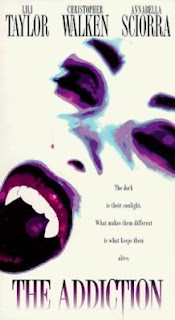
Review of Abel Ferrara's The Addiction (1995)

The Addiction film poster

Conclusion


A slow moving, yet slick black and white take on vampirism. No Victorian garb, no corsets and no mortals painstakingly trying to convince vampires to turn them into immortals.

The Addiction
is widely regarded as an allegorical tale of drug addiction, but there is inconclusive evidence to dispel my theory that the main character is brainwashed to believe that she is a vampire.

Plot


Kathleen Conklin (Lili Taylor) is a philosophy student who is shocked to learn about the My Lai massacre in one of her lectures. After escaping this environment of controlled information flow, she walks home in a state of emotional distress.

A vampire wench (Annabella Sciorra) attacks Kathleen by dragging her into an alley, making big eye scary faces and prompting Kathleen to order her to go away. Kathleen is caught off guard slightly, because those in humanities tend to be timid. Come to think of it, they also tend to be bucktoothed trend whores. The outdated (c)Rap music on the soundtrack testifies to that.

vampire from can stock photo
Is The Addiction about vampires? Photo courtesy of Can Stock Photo.

"Order me to go away"
Kathleen yelps a pathetic "please..." and the vampire wench bites her. Clearly, ambiguity is not a wise recourse when dragged into a darkened alley by someone taller than you. The vampire wench licks the blood off her own chin in a manner which suggests she regularly goes out with the sole purpose of ingesting the body fluids of impressionable girls. I can relate somewhat.

"It's not my actions but your incredulity that needs examination here"
Reborn as a vampire, Kathleen acclimatises herself to her new condition. She systematically upgrades from the morally grey area of using hapless homeless people as makeshift blood banks by drawing their blood inconspicuously to view the world in more black and white moral terms.

These terms position her as a predator of the ultimate mammalian predators. Only vampire rules apply to her, which is why she tells one of her shocked victims: "It's not my actions but your incredulity that needs examination here".

But all is not ponies and rainbows. Kathleen becomes self-destructive and realises she needs a little guidance in her newly-found vampire reality tunnel.

drug addict courtesy of Can Stock Photo
Or could The Addiction be about drug addiction?

There's no such thing as a free Naked Lunch
Peina (Christopher Walken) counsels Kathleen. He is allegedly a vampire who has overcome his thirst for blood. While comforting Kathleen in a slightly inappropriate sage-like manner, he considers it an apt time to start a book club. William S Burroughs' Naked Lunch makes the top of the list for that week.

"I'm not like you, you're nothing"
Seemingly converted to the fasting and meditation of Peina, Kathleen manages to finish her doctoral thesis. She has a graduation party but then all her colleagues in attendance get mauled in an orgiastic blood drinking rite.

Kathleen becomes ill and ends up in hospital. She asks the nurse to open the blinds, which would traditionally kill a vampire. The original vampire wench arrives to close the blinds again, claiming that suicide will not end the quest for rest. Kathleen has a change of heart, as opposed to just a change of blood, and confesses to a catholic priest.

"Self-revelation is annihilation of self"
The closing scene features a shot of Kathleen's grave. She lays a rose on her own grave, and then walks away.

Review


On the surface, it seems like an obvious allegorical tale of heroin addiction. The cravings, the mainlining, the mucking about in darkened alleys all seem to contribute to this allusion, but upon closer inspection it becomes apparent that the subtext is one that parallels Lifton's eight criteria for thought reform.

Nun from Can Stock Photo
Or is The Addiction about mind control?

Lifton's Eight Criteria for Thought Reform
  1. Milieu Control: Controlling the flow of information in a setting such as this is not a logistical nightmare. The entire film takes place in what appears to be one block in the Bronx. A vigilante group of vampires can likely overcome their fears of hepatitis and condition a victim such as Kathleen to also overcome similar fears by exercising control over a relatively small environment.

  2. Mystical Manipulation: Someone with fangs jumping you on a street corner in the middle of the night would arguably count as a mystical manipulation. Similarly, Peina claims some mystical manipulation of his thirst for blood. This is despite offering no evidence that he is in fact a vampire.

  3. Demand for Purity: Between Peina and the original vampire wench, Kathleen is expected to be either a vicious predator or an aloof ascetic vampire. To them, a golden means is not possible within their group. This is despite Kathleen's initial reaction of acquiring blood in less sinister ways and then mainlining it. Not exactly kosher, but less conspicuous than dealing with a large number of unpredictable converts.

  4. Confession: Peina and the vampire wench stalk Kathleen and keep tabs on her actions. They appear at opportune and inopportune times to present themselves as benevolent creatures. It is doubtful that they have Kathleen's best interests at heart, especially since the vampire wench and Kathleen apply a little Affirmative Action of their own on Kathleen's faculty staff.

    Kathleen has no confidentiality. All her actions are made known to the others of the group, either by her own admission or by some apparently mystical manipulation.

  5. Sacred Science: None of Kathleen's actions seem to be good enough for the group. If she chooses the option of becoming a vicious predator, Peina reprimands her. If she chooses the path of aloof ascetism, the vampire wench convinces her to leech on her faculty staff. Either way, the group's doctrine is not to be questioned by Kathleen.

  6. Loading the Language: The group clearly has its own jargon. Phrases such as 'order me to go away' obtain new meaning within the context of this group, and Kathleen even begins to hurl similar jargon at her victims. In the view of this group, the victims are the ones who are to blame for being at the mercy of vampires because they are not strong enough to offer any resistance.

  7. Doctrine over person: Personal experiences are considered irrelevant and subordinate to the experiences the group prescribes. In light of this doctrine, it becomes more clear why Peina and the vampire wench seemingly contradict each other. They are instilling a doctrine over the person of Kathleen by breaking down her mental resistance.

  8. Dispensing of existence: Clearly, the group has the final say in who stays and who goes. Kathleen was chosen to be at the mercy of the group, and Kathleen has no way of getting out of this situation. Not even when she attempts suicide. Kathleen's individual existence is valuable to the group, for reasons unknown, and her existence will only be allowed to come to an end when the group decides that her existence is dispensable.

It is truly shocking that all of Lifton's eight criteria for thought reform are met by religious and political movements, but The Addiction is a pretty cool movie. Despite no inexplicable booby shots. It is an attempt at an art for art's sake film, so it doesn't really qualify as a horror movie. Its slow pace, its loaded language, its lack of flashy editing and its tiresome scenes of agony might not appeal to other gorewhores out there, but I thoroughly enjoyed it.

Ken Kelsch is a brilliant cinematographer and deserves a special mention. The shots are composed exquisitely and they manage to make the black and white format come alive. This is despite the film being shot in only 20 days!

The Addiction proves that sometimes buckets of blood and inexplicable boobshots are not required to produce a compelling film. Sometimes an existential crisis brought about by attempts at thought reform are sufficient.

Director


Abel Ferrara

Cast


Edie Falco,
Michael Imperioli,
Annabella Sciorra,
Lili Taylor,
Christopher Walken.

Rating


Horror film review most excellent rating skulls on the Necro Files. Heavy metal album reviews

12 June 2008

Review of Politics of Ecstasy by Nevermore

Nevermore Politics of Ecstasy album cover

Conclusion


Soaring vocals, snarling guitar riffs and incredibly inventive playing. Plus it is a concept album, so I'm sold.

Review


Jeff Loomis plays guitar for Nevermore. You really should need no further convincing, but Pat O'Brien exchanges riffs of Hades with Loomis on this album. It rarely gets better than this.

It took me quite a while to get used to Van Williams' metronome-like drumming. At first, I didn't really get into it because I am accustomed to flashy drummers like Richard Christy, who employ loads of cymbals. After a while, the incredible precision took its toll and I can't really picture any other drummer in Nevermore.

Van Williams employs more drums, making his playing more brutal. That's the ultimate strength of this band - every player is a merited working part of the machine. This reminds me of what Legalism had in mind for government.

Legalism as personified by Nevermore


Legalism is one of the four prominent schools of Chinese philosophy during their Spring and Autumn period, the others being Taoism, Confucianism and Mohism.

Taoism deals with the true nature of matters, which is why Megadeth and Slayer personify Taoism in my books. Confucianism taught an unconditional hierarchy of specialised filial relationships while Mohism taught equality of all people, and these are not really applicable to Nevermore (or anywhere else, really).

Legalism on the other hand focuses on trying to establish a meritocracy.

Han Fei's proposals for leadership under legalism


  1. Fa: Law or principle. It is obvious that metal is the law for Nevermore. Legalism considers all people equal before the law, but holds that the law must punish those who break the law and reward those who abide by it. This is why Trivium is punished with bottles of piss and Necrophagist is rewarded with awesome Ibanez guitar endorsements.

  2. Shu: Secret tactics. These are used by the ruler to maintain the law. Nobody should be able to fathom the tactics of rule to the extent that they would want to establish rule by themselves. The idea is that subjects would see no other alternative to getting ahead other than following the law.

    When they follow the law, they think they are acting towards their own benefit. In principle, they are acting towards their own benefit within the meritocracy but they are also acting towards maintaining harmony. Nevermore's secret tactics include hiring jaw-dropping session musicians like Chris Broderick.

  3. Shi: Legitimacy. The position of the ruler must hold power in itself by virtue of the law. The ruler is merely the catalyst for the law. Jeff Loomis is definitely a legitimate guitar god any way you look at it - legally or illegally.


Metal became known for death vocals lately, but some exponents still stick to the standards of Dio, Halford and Dickinson. Nevermore is one such band. While the vocals does get rough at points, it never goes into death growls. This means you can actually hear what Warrel Dane is singing about. Unlike Metallica, it's not a case of you'd rather not hear the tripe he is singing.

Jeff Loomis guitar god
Jeff Loomis. Guitar god by day, merchant of menace by night.

The album title is from the book by Dr Timothy Leary of the same name, however Dane has stated that the album is more about control issues and spirituality than better living through chemistry. Thus, the album has more in common with politics than ecstasy. You really need not concern yourself with any of these concepts. The ultimate proof of a successful concept album is that the music speaks for itself, and it does on all Nevermore albums.

Track listing


  1. The Seven Tongues of God

  2. This Sacrament

  3. Next in Line

  4. Passenger

  5. The Politics of Ecstasy

  6. Lost

  7. The Tiananmen

  8. Precognition

  9. 42147

  10. The Learning

  11. Love Bites (Bonus track)


Personell


Rating


Heavy metal reviews. Top horror movies. Rating skulls from the Necro Files

10 June 2008

Doppelganger (1993) Review

Doppelganger, the Evil Within film poster

Conclusion


This high budget lameness resembles a pretty cool metamorphosis scene with big latex heads, a few buckets of blood and lots of ooze with a half-baked plot added as an afterthought. The doppelganger idea is charming and could be seen as a metaphor for the main character's struggle to come to terms with her higher circuits of consciousness, scared to unleash a monster as it were. Or maybe not, but that's my version and I'm sticking to it.

Plot


A girl (Drew Barrymore) is stalked by her doppelganger in this obvious allusion to her shady drug habits and the resulting explorations of Dr Timothy Leary's 8-circuit model of consciousness. Well, not really. Most of the film is just plodding and dull so I added my own subtext.

Review


"To see the world in a grain of sand, and to see heaven in a wild flower, hold infinity in the palm of your hands, and eternity in an hour." - William Blake

No, William Blake was not on acid. At least not the same acid that Dr Hoffman synthesised. His auguries of innocence do however seem to describe the same kind of phantoms summoned by Dr Timothy Leary with the auguries of lysergide.

Dr Leary did serious psychology work for a while. His interpersonal circumplex model is still used to evaluate and differentiate between personality disorders. After a colleague introduced Leary to psilocybin mushrooms, his area of expertise changed drastically. It is during this period of intense experimentation with psychedelics that Dr Leary developed his seven levels of consciousness model, which he dubbed 'the Seven Tongues of God' (Nevermore fans rejoice!). This model was later improved by Dr Leary and Robert Anton Wilson, after ingesting more drugs in greater quantities. It developed into the 8-circuit model of consciousness.

Dr Timothy Leary, doppelganger for delinquency.

Dr Timothy Leary, doppelganger for delinquency.

Dr Leary's 8-Circuit Model of Consciousness


According to Dr Leary, the old left brain/right brain consciousness model is more than just the smart maths side versus the dumb arty side. The left side represents our primal modes, needed for our survival, while the right side represents our more divine levels of consciousness, needed for evolution. While it is crucial to awaken the levels of consciousness of the left side in order to survive, it is not necessary to develop the levels of consciousness of the right side of your brain, unless of course you want to have some fun.

The Seven Tongues of God


These refer to the seven basic spiritual questions.

  • The Ultimate Power Question: What is the basic energy of the universe?

  • The Life Question: What is life?

  • The Human Being Question: Who is man?

  • The Awareness Question: How does man know?

  • The Ego Question: Who am I?

  • The Emotional Question: What should I feel about it?

  • The Ultimate Escape Question: How do I get out of here?


Robert Anton Wilson added an eighth tongue – What if there are others out there? This might have severe theological ramifications, because in order to accommodate 8 tongues it means we'd have to picture god as Medusa. Unless of course your god is Cthulhu, in which case there are more than enough allegorical tentacles to go around. But wait, there is more!

Medusa. Gorgon. God?

Medusa. Gorgon. God?

The 8-Circuit Model of Consciousness


Dr Leary assigned each level of consciousness to each of the basic spiritual questions. He further claimed that each level could be achieved with the appropriate contraband.

  • The Bio-survival Circuit differentiates between danger and safety. Infants on this level crawl forwards or backwards. It is stimulated by drugs which offer pain relief (opiates like codeine or morphine).

  • The Emotional Circuit is concerned with emotion. This mode of consciousness differentiates between submissive and dominant. Infants at this level become aware of up and down. Alcohol stimulates dominant and submissive thinking.

  • The Symbolic Circuit deals with logic and abstract thought. It is concerned with dexterity and handling artefacts. At this level, infants become aware of left and right. Stimulants like caffeine and cocaine stimulate this mode of thinking.

  • The Domestic Circuit offers tribal awareness. Leary never associated a drug with it, but others have suggested endorphins. This means chocolate!

  • The Neurosomatic Circuit is where things get more interesting. The previous modes of consciousness are all affiliated with orientation within an Euclidean geometrical system. The neurosomatic circuit is concerned with orientation outside of fixed points, such as when one floats in water or when one free falls. Leary postulated that we need this kind of consciousness for when we walk in space someday. Marijuana is used to disorient your perceptions of Euclidean space-time.

  • The Neuroelectric Circuit is when the mind becomes aware of its personal consciousness. Leary suggests that telepathy occurs at this level. Psilocybin and peyote are used to activate this circuit.

  • The Neurogenetic Circuit allows the mind to become aware of the group mind of its species, or awareness of its collective consciousness. LSD is used to activate this circuit.

  • The Psycho-atomic Circuit is when the mind becomes aware of super intelligence, or god. Cthulhu is in the ketamine.


What about Doppelganger?


Just like contraband serves as a shortcut to various circuits of consciousness, I will give you a shortcut to the worthy scenes in this film. When watching this movie, skip to the following highlights and cut approximately 50 minutes of dullness from your life:

  • the opening, which has a sex scene and a murder back to back

  • Drew Barrymore in the shower, with bloodshed on her boobies

  • any scene with Leslie Hope, as her character is the only one worth watching. One of her scenes involves Americans pronouncing doppelganger. Hilarious!

  • scenes featuring Drew Barrymore with both a pair of shades and a large knife. Note: both accessories, because when she has only one of them nothing happens

  • the transformation scene. Don't worry, you'll know


Director


Avi Nesher

Cast


Rating


When skipping to the suggested cool scenes:
necro files horror movie reviews heavy  metal albums rating skulls awesome
When watching the entire film:
necro files horror movie reviews heavy  metal albums rating skulls awesome

24 May 2008

Why Nietzsche was not a nihilist and why you are forever trapped in the Wizard of Oz (part three)

This is a three part series. You can find all of the parts here:
  1. Why Nietzsche was not a nihilist and why you are forever trapped in the Wizard of Oz (part one)

  2. Why Nietzsche was not a nihilist and why you are forever trapped in the Wizard of Oz (part two)

  3. Why Nietzsche was not a nihilist and why you are forever trapped in the Wizard of Oz (part three)


Wizard of Oz, Doroty, Lion, Tin man, Straw man and Toto
Dorothy and her motley crew. Armed with the will to power, these are dangerous intellectuals who undermine the authority of the state.

Why Nietzsche was not a nihilist


This is the third and final part, explaining why Nietzsche claims you may be perpetually trapped in the Land of Oz. At the very least, you are perpetually trapped on the yellow brick road.
  • Considering Nietzsche's own testimony of his war method, we find that nihilism has all the characteristics of one of his worthy adversaries. Nihilism is a cause that is victorious. It is a cause against which he would not find allies easily, because his only allies would be deists, and these are hardly friendly with Nietzsche after such exhilarating titles such as Beyond Good and Evil and The Antichrist. It follows that Nietzsche would stand alone if he opposed nihilism, which he did in his writings. In fact, in The Antichrist, Nietzsche calls nihilism the will to nothingness, which is contrasted with the will to power. Nietzsche thus sees nihilism in opposition to the will to power. He identifies nihilism as a natural reaction of the Judeo-Christian perspectives to the notion that God is dead, and claims that nihilism is necessary in order to restore the healthy will to power in the populace.

  • Considering the opposition of Apollonian and Dionysian impulses in art, it is easy to equate nihilism with a new world order. Nihilism represents the new Apollonian dynasty. With Nietzsche's methods in mind, it is obvious that Nietzsche would rather be the Dionysus of the new dynasty if the new Apollo already showed its face. Only an Apollo that could withstand the attacks of its Dionysus would be worthy of instilling the master morality of the new generation.

  • Considering Nietzsche's radical perspectivism, one finds that Nietzsche acknowledges nihilism as a valid perspective, but he does not think that it is sound. Nihilism claims that there is no purpose to existence. Nietzsche believed in eternal recurrence. Eternal recurrence is a kind of determinism, meaning we don't really have free will. Eternal recurrence holds that time is infinite, but matter itself is finite. Since matter is finite, the exact combination of matter is likely to occur several times during the course of infinite time. With regards to the yellow brick road, nihilism says there is no point in moving either way along the yellow brick road. The thought of eternal recurrence holds that if we equate the yellow brick road with infinite time, the yellow brick road would extend forever beyond and before the Emerald City. In such an universe, it is likely to encounter the nihilists sitting on the side of the road, claiming the road leads nowhere. It is likely to encounter several Dorothies at various points along the road, and these various points would all be exact replicas of the Land of Oz. In other words, Nietzsche inverts the nihilistic notion that the yellow brick road leads nowhere and claims instead that the yellow brick road leads everywhere else.

  • Considering Nietzsche's theory of master and slave moralities, one could deduce that Nietzsche's purpose is to test all master morality of the next generation. His perspective offers the hindsight of nihilism and Christianity, with its dogmatic requirements of the supernatural and of objective morality. Since these values are attributes of the fallen master moralities of old, Nietzsche rejects them outright. These values are too close for comfort to the values of the wizards who were already behind the curtain, and thus neither nihilism nor Christianity are worthy of pulling the levers in the sequel to the Wizard of Oz.


Emerald City, Wizard of Oz
The Emerald City on the horizon. Eternal recurrence claims we may be forsaken to return to the Land of Oz. Forever.

In conclusion, it is clear that Nietzsche's notions of the will to power, the opposition between Apollonian and Dionysian impulses in art, the struggle between master and slave morality and eternal recurrence are incompatible with a nihilistic world view. His concepts of the übermensch and the last man represent two possible reactions to nihilism, with the übermensch being one that successfully transcends the pessimism of Schopenhauer by utilising the will to power and the last man being one who falls prey to nihilism, the will to nothingness. The last man is tired of living, he takes no risks, he sees no solutions, he seeks comfort and security. In contrast, the übermensch sees utility in place of the last man's futility.

Ruby slippers
Ruby slippers. Futility for the last man. Utility for the übermensch.

Sources consulted


Why Nietzsche was not a nihilist and why you are forever trapped in the Wizard of Oz (part two)

This is a three part series. You can find all of the parts here:
  1. Why Nietzsche was not a nihilist and why you are forever trapped in the Wizard of Oz (part one)

  2. Why Nietzsche was not a nihilist and why you are forever trapped in the Wizard of Oz (part two)

  3. Why Nietzsche was not a nihilist and why you are forever trapped in the Wizard of Oz (part three)


Nietzsche's perspective: Someone has to be the next Wizard of Oz and it might as well be one of us


Winston Churchill said that democracy is the worst form of government we could possibly have, except for all the others we have tried. This sums up what Nietzsche might say if he discovers that there are no more wizards behind the curtain in the Land of Oz. The next wizard would have to be less bad than the previous ones we had. In other words, any wizard different from previously flawed wizards would suffice. This explains Nietzsche's adversity to the Wizard of old, namely Christianity, and his adversity to the Wizards of his day, namely nihilism, nationalism and anti-semitism. But let's have the man speak for himself:

Nietzsche's methods: His practice of war


“My practice of war is formulated in four principles:
  • ...I only attack causes that are victorious...

  • ...I only attack causes against which I would find no allies, so that I stand alone...

  • ...I never attack persons...

  • ..I only attack things when all personal differences are excluded, when any background of bad experiences is lacking. On the contrary, to attack is to me a proof of goodwill, sometimes even of gratitude...”

This is taken from Ecce Homo, Nietzsche's sarcastic review of his own life and his own works.

Wicked Witch of the
The Wicked Witch of the West. Prime exponent of master morality. One example of perspectivism.

Nietzsche: The Toto of the yellow brick road.


Critics of Nietzsche claim that his philosophy has no purpose and that he is without conviction. This proves to be inaccurate when one considers common themes in his philosophy.
  • The opposition of Apollonian and Dionysian impulses in art: The Greek gods Apollo and Dionysus represent a struggle between order and chaos in art. While they were not rivals in the classical mythology sense, their aspects are thought to be in conflict in works of art. Apollo represents order, stability and harmony. Dionysus represents primal nature, chaos, ecstasy and intoxication. In short, Apollo represents the perspiration and Dionysus represents the inspiration.

  • The will to power: Darwin postulated that only the fittest survive, and evolution is the process of determining which physical characteristics are most desirable to enable the fittest to survive. It is thus the strong that rule the weak. With regards to Schopenhauer's will to live: those with a stronger will to live, survive those with a weaker will to live.

    Nietzsche claimed that the weak rule the strong (the meek shall inherit the earth, as it were), because the process of evolution serves to strengthen the weak and weed out the strong. Nietzsche claimed the will to power overrides even the will for survival. In other words, a will to power could even cause an organism to sacrifice its own life for a cause, thus contradicting that survival in the Darwinian sense is its ultimate cause.

    Recent discoveries in biology such as genetic drift affirm that survival of the fittest only becomes the overwhelming criterion when the survival of a species is threatened. In the absence of immediate threats to survival, genetic drift largely determines physical characteristics. Nietzsche's will to power is an attempt to explain why members of a society carry on growing and establish a hierarchy, despite the absence of a threat to their survival and by extension, despite an apparent purpose. In terms of the Wizard of Oz, each member of Dorothy's company had a different reason for going to see the Wizard, and none of these reasons were survival. Each of them exhibited a will to power.

  • Slave morality and master morality: To Nietzsche, master morality weighs actions according to their consequences. The essence of master morality is nobility. Slave morality weighs actions according to their intentions. The essence of slave morality is utility. Morality in this sense suggests certain codes and norms of a society. Masters of a society establish these norms by considering consequences. Slaves of a society evaluate what the masters establish, in other words they affirm or reject the values established by stronger willed members. Slave morality and master morality are in conflict to create a moral middle ground. Dorothy represents master morality in the Wizard of Oz, and her companions are evaluating her intentions. When they find her motives to be in harmony with theirs, they accompany her on her journey down the yellow brick road.

  • The claim that God is dead: Because of the advent of nihilism, God (capitalised, to indicate the Judeo-Christian conception of god) is dead because He is no longer considered a valid source of objective morality nor a cause of existence. In other words, Dorothy and her friends arrive in the Emerald City and they find that the wizard is an old man behind the curtain pulling levers. The wizard of Oz as they understood it is dead. For all intents and purposes, their god is dead.

  • Radical perspectivism: Nietzsche claimed that all ideas originate from a particular perspective. There are many perspectives, and thus many different truths, but not all truths are equally valid or equally sound. Dorothy's perspective is that the wizard of Oz knows how to send her back to Kansas. The Wicked Witch of the West's perspective is that Dorothy represents a threat to the reign of terror, and Dorothy had to be eliminated. Dorothy's perspective was valid, considering her source of information, but not sound. The Wicked Witch of the West did have a valid and sound argument. From our perspective, she is a Wicked Witch because she interferes with Dorothy's plans to get back to Kansas. From her perspective, Dorothy threatens the moral fibre, because the Munchkins are not hapless slaves any longer.


Munchkins
Munchkins. Prime exponents of slave morality. Übermenschen, not so much.

It is clear that Nietzsche's philosophy did have meaning. To put it succinctly, since Nietzsche's philosophy had meaning, he could not have been a nihilist. For the more elaborate version, see the third part of his series.

Why Nietzsche was not a nihilist and why you are forever trapped in the Wizard of Oz (part one)

This is a three part series. You can find all of the parts here:
  1. Why Nietzsche was not a nihilist and why you are forever trapped in the Wizard of Oz (part one)

  2. Why Nietzsche was not a nihilist and why you are forever trapped in the Wizard of Oz (part two)

  3. Why Nietzsche was not a nihilist and why you are forever trapped in the Wizard of Oz (part three)


A brief outline of nihilism


Friedrich Wilhelm Nietzsche is the one philosopher whose name is synonymous with nihilism. While there are similarities between nihilism and Nietzsche's philosophy, I do not believe it is accurate to claim that Nietzsche was a nihilist. In order to motivate my viewpoint, we will have to consider brief outlines of both nihilism and the philosophy of Nietzsche. Note that these are working definitions and my citations are mostly from Wikipedia. I am not a philosophy expert.

Picture of Nietzsche
Nietzsche. Strapping young lad. Godless heathen. Nihilist, not so much.

The shocking claims of nihilism: there is no wizard behind the curtain, and even if we had a wizard it means nothing


Nihilism claims that existence itself is meaningless. It follows that there is no purpose to existence. The basic tenets of nihilism are:
  • Objective morality does not exist. One course of action is not preferable over another.

  • Since there is no objective morality, existence has no purpose.

  • There is no credible evidence of supernatural beings. Even if there are supernatural beings, we are not obliged to worship them.

The fact that Nietzsche is credited with the axiom 'God is dead.. and we killed him' is not really helping to separate the wheat from the chaff either. Before we consider Nietzsche's philosophy, we need to consider the inherent problems in the philosophy of nihilism and an outline of Nietzsche's methods, or his raison d'etre if you will.

Inherent problems with the philosophy of nihilism: but there is a land of Oz with a yellow brick road


  • Subjective morality does exist: The lack of objective morality is not reason enough to assume that there is no morality. It is not even reason enough to assume that morality is immoral, but perhaps enough reason to assume that morality is amoral. For instance, it is generally regarded that murder is wrong. This dogma does not point to objective morality, but it is consistent in virtually all cultures, and exceptions to this rule are just that – exceptions to the rule. When Dorothy kills the Wicked Witch of the East, it is reason for mirthful celebration and ponies and rainbows. No Munchkin demands Dorothy's head on a platter. There are exceptions to the rule that murder is wrong, and while it points to a lack of objective morality, it does not indicate complete lack of morality. It indicates subjective morality.

  • Existence is a purpose: 'Existence has no purpose' is an empty statement. This is akin to Dorothy seeing the yellow brick road, but deducing that it disappears over each horizon, and therefore the yellow brick road goes all around the world and ultimately leads back to this exact same spot. What is her purpose then for following the yellow brick road?

    When examining this statement critically, it first needs to be falsified. Nihilists would have to define conditions for existence to have a purpose. Further complications aside, if you define objective morality as the condition and if you fail to prove that objective morality exists, then you could deduce that existence has no purpose. Perhaps this is why a statement like 'god is dead' is so shocking to religious people. To them, god is the ultimate objective gauge of morality. No god means no objective morality. No objective morality means no purpose. Everyone without god (including Nietzsche) must therefore be nihilists, since they do not believe in the ultimate reason for existence of those with a god.

    The axiom that existence has no purpose is fallible. What if the purpose of existence is to realise that existence has no purpose, and the purpose of existence is to overcome this existential crisis? This would mean that existence does have a purpose, which refutes the axiom. To summarise, what if the meaning of life is to give meaning to life? It is thus likely that the wizard of Oz built the Emerald City and established himself as ruler in order to give meaning to his life. While this exercise is ultimately futile, it suggests the notion that any action is better than no action. Nihilism proposes no action, since any action is ultimately futile. The Wizard of Oz proposes that any action has a purpose, if only for its immediate reactions.

  • There is credible, but not conclusive evidence that there are no supernatural beings: In other words, there is not enough evidence to suggest that there is no tribe of flying monkeys. The statement 'there is no credible evidence of supernatural beings' would also have to be falsified. Nihilists would have to define conditions which would indicate evidence of supernatural beings. I for one agree with nihilists, but I can not prove conclusively that there are no supernatural beings. The lack of credible evidence supporting supernatural phenomena is also my main argument, and the natural scientific explanations of most supernatural phenomena to date are my conditions for falsifiability. If flying monkeys have a natural explanation, they aren't supernatural, but it does not mean that flying monkeys do not exist.


Nihilists and religious thinkers thus suffer from the same Achilles heel. Both ultimately rely on supernatural beings as a condition for objective morality. Both rely on objective morality is a requirement for the purpose of existence. Which side does Nietzsche take in this school yard brawl?

Google sucks piles I'm moving to Steemit

Short and sweet, Google isn't allowing me to post ads on my blogs here on blogspot any longer. Not that I provide my angry nerd rants fo...