Showing posts with label capitalism. Show all posts

08 June 2017

Private property is theft, personal property is fine

That awkward moment when reality meets your ideology. Some anarcho-communist is having a fanny wobble because informal settlers got evicted in Newtown. But wait! Anarchist communism doesn't approve of private property, only personal property. So on what grounds does anyone have the right to reside anywhere?

Property is theft

You may ask:  Isn't this maxim a bit of a wank?

Let's try to unpack this bromide which was so obviously flawed that even Karl Marx could see its shortcomings.
  1. You're allowed personal property, so things like bicycles and underwear.
  2. You're not allowed private property, so you can't put up a fence. Ouch, right in my rent-seeking feels!
The corollary is that you're allowed to have stuff like bicycles and underwear, but you're not allowed to keep your stuff anywhere. You're also not allowed to own stuff like bicycle and underwear factories. Property is theft! But only private property. Personal property is the category error we invented.

The Vespa Militare. In the abscence of property rights, all personal property bicycles would probably be have to look like this? Read more about the bazooka Vespa here!

But no, it's not a bit of a wank, you pleb. This ad hoc hypothesis oops I mean well-founded ideology of the ages is just too deep for you to understand. You just need to read (insert author you've never heard of for the plain and simple reason that they're not worth being read here). 

Because they too repeat bromide aphorisms designed to impress impressionable minds, but they take much longer to get to the point which you so rightly pointed out is a bit of a wank. 

Hang on while I reinvent the wheel so I can explain who should produce things like bicycles when they have no ownership claim on where to manufacture them, and who would purchase bicycles when they have no ownership claim on where to put them once purchased.

Kim Jung-on, at least one emperor who isn't naked. He doesn't believe in property rights either.


But I'll never admit that my emperor is naked, not even when he is sans underwear! You just don't knit underwear very well with your eyes!

20 April 2012

Sexual Violence against Women in South Africa

Regular readers would know by now that feminism is somewhat of a whipping boy for me. This is part of why my knee-jerk reaction to the sophistry that rape in South Africa is perpetuated by the usual suspects of patriarchy, men's sexist attitudes and the terrible Protestant capitalist upbringing forced upon us - not to mention that age old scapegoat The Media and its photoshopped princesses - is one of disbelief.

How sexist am I? Apparently somewhere between male and female hostile sexists, but less benevolently sexist than most people who participated in the Ambivalent Sexism Inventory questionnaire.

In the nature-versus-nurture debate, I put more stock in sociobiology than in the products of society theory. Putting the knee-jerk behind me, I decided to suspend judgement and look at the data before I chop off my genitals and become a nun (or a none?). As before, regardless of what most people would have you believe about feminists and their hysteria, and regardless of what most of them rationalise lies behind the serious issues, we do have a serious problem on our hands in South Africa. We need to do something about the fear that women in South Africa live with - a realistic fear of violence and particularly rape.

How do we know that our culture produces rapists?

This statement - widely believed by feminists (their labelling, not mine) - assumes several initial points:
  1. South African cultures condone or promote rape.
  2. Rapists are mostly socially constructed. That is, a rapist is someone whose actions are instigated and controlled to such an extent by his cultural milieu that committing rape is somewhat of an inevitability.
  3. The prevalent attitude of South African men is sexist
  4. There is a link between this generally sexist attitude of men and our high incidence of rape.
Unlike what one would expect from a cultural milieu that socially constructs beasts of sexual violence, most men in South Africa are not rapists. This presents a problem to the analysis that we're merely suffering from a patriarchy hangover. Paradoxically, this fact does not fill me with joy because it means solving the problem is far more difficult than handing baby boys Barbie dolls and Cosmopolitan magazines to play with in their formative years.


If not for sexism, why do South African women live in fear?

I don't believe that sexism is appreciated or condoned by our culture. Of course, there are so many cultures in South Africa that such a statement - and the statement that our culture produces rapists - is essentially meaningless. I only have anecdotal evidence to go by, but believe me telling a girl to knit you a sweater and make you a sandwich will not win you many friends of either gender in my circles.

However, the high incidence of rape in South Africa is somewhat worsened by culture. In particular, there are some superstitious beliefs that hold having sex with a virgin will cure you from AIDS. There are also cases of corrective rape, designed to cure unfortunate lesbians of their preference for women. Most rapists are likely to be male and between the ages of 20 and 40. Furthermore, alcohol and spousal abuse are factors that make your chances of getting raped more.


Is rape a gender issue?

Of course such a statement is anathema to me. There is a difference between sex (broadly male, female and other) and gender. Gender is tied with particular social and cultural roles. Suffice to say I am not familiar with a cultural practice in South Africa that condones rape - bar the mentioned voodoo sangoma witchdoctor cures for AIDS and lesbianism. Also bar the lip service that some establishments like the church pay to condemning rape while their servants get caught in the act of child abuse a little too often to lend much weight to their official dogma.

Culturally, the official dogma is still that rape is something that is frowned upon - to say the least. Plus, many men are raped in prison too. However, for the most part, rape victims are female (of any gender) and rape perpetrators are men (who don't deserve their gender bits). I do not believe that we live in a culture whereby men's attitudes are mostly sexist. Of course such attitudes exist, but not disproportionately to the rest of the world. The rest of the world doesn't have a rape problem of our proportions, which again contrasts to the expected situation if rape were merely a result of anachronistic gender attitudes and bias. Furthermore, I couldn't find a study that measured the gender attitudes of South African men. The only stats I could find refer to rape victims and their terrible ordeals.

Whether you put stock in the whole patriarch equals rapist conjecture or not, the harsh reality is getting raped is not a realistic fear most men have to live with - not even in Cape Town's Pink Triangle. Even worse, most women in South Africa are living with a realistic fear that they could be raped. And yes, it does get worse: When women are raped, they are mostly too afraid and ashamed to report the crime to the authorities.

As ridiculous as most humanities subjects are to those of my Vulcan ilk, the concerns raised do not strike me as being ridiculous or based on hysteria. This judging by the testimony of those working in the field of sexual violence, dealing with rape victims on a daily basis, whether you buy into their ideology or not. 


What can we do to remedy the situation?

Even if rape in South Africa did result from our cultural milieu, fixing that requires a generation or two and it's impractical to construct a measure of the change or a measure of the results of such change. We would never know if we're socially constructing the right kinds of rape-free genders. We need something that we can do right now to make women feel safer in our society. While most men are not rapists, statistically, most of us should be familiar with a rapist. We cannot afford that rape is something other men do and we can do nothing about. Furthermore, most rape victims know their rapist fairly well. I think a good place to start is with ensuring that women who were raped are not afraid of reporting the crime and have some faith that they can talk to someone who will be able to help.

Another good place to start is to have a Designated Dave kind of character to help prevent rape. Just like Designated Dave takes care of the driving while you take care of the drinking, this character takes care of your drink when you go to the bathroom and generally ensures that whatever you get up to by means of sharing DNA samples is consensual.

What do you think?

Please feel free to leave me a comment so we can find a working solution. As someone who does not associate with feminism or any ideology except Incertitude, I would like to become familiar with working solutions. For the time being, the only such solution I have found is chemical castration.

Sources

I have linked to sources throughout the text. I did my best to sidestep the ideological landmines, but the best sources on rape I could find deserve another mention:
  • Understanding Prejudice, a site dedicated to the Ambivalent Sexism Inventory. This is a questionnaire (survey to you Merkins) designed to determine how much you hate sex. I mean, gender.
  • Violence against women, a World Health Organisation study of 2011. Yes, not something from the Middle Ages I'm afraid.

01 October 2009

Metacritique of "The Objectivist Ethics"

The following responds to a critique of "The Objectivist Ethics". Regular readers might have guessed that I am a bit of a Randroid. My numbering corresponds to the numbering of the author. To follow things smoothly, you have to read the critique and my metacritique next to each other.

1. Rand's argument


Objection to i
The fact that Ayn Rand does not offer an argument for 1 does not make it false. This piece does not offer a counter argument. That besides, Ayn Rand bases Objectivism on axioms. Per definition, axioms are not proven but assumed to be true.

Objection to ii
The alternatives need to be there for either schools of value to be satisfied. Absolute good is in contrast with less good options, relative good is in contrast with other worse options. A million US dollars, or South African Rand, has to be compared with something of lesser value (a million Zimbabwean Dollars, for instance) to be considered valuable.

Objection to iii
Non-living things cannot make value judgements as far as we know. This is the point of the fact that they cannot face alternatives: they cannot choose to be living things. We can.

Objection to iv
These two interpretations, oddly enough, seem to reinforce the idea that value has to be of value to someone. Value as a verb implies an agent that values. Value as an absolute implies comparison with less valuable or more valuable things, which begs the question valuable to whom? This again implies an agent that compares.

Objection to v
The implicit premise 7 is derived incorrectly.

Rand's premise: 6. Every living thing acts to maintain its life, for its own sake.
The author's implied premise: 7. There is no other thing that they act to gain or keep for its own sake.

In other words, agent does x because of y. This does not mean that an agent can't do z because of y (or an agent can't do other things merely for their own sake). Rather, Rand's implied premise seems to be that an agent cannot do x because of z (namely an agent cannot act to maintain itself for the sake of someone else), not that there are no other things that agents do for their own sake.

The author focuses on this incorrect premise 7, thus v is a classic strawman argument. It is important to read the entire 6 and to understand that agents act to maintain themselves for their own sake. v claims that this implies innate values, which it does not. As per 2 and 3, Rand claims that agents choose among alternatives according to what they value. Thus, values cannot be innate as instinct. They are a result of volition. Rocks cannot act to satisfy value systems, regardless of the value their kinetic energy might have to us.

Objection to vi
This breaks up 6 and gets lost in semantics. Again, 6 claims agents maintain themselves for themselves. Nothing more.

Objection to vii
This again focuses on the incorrectly derived premise 10. Rand stated that an agent's life is its ultimate value, at the heart of its values. This is why Rand stated that life is valuable for its own sake. It is thus rational to act in order to promote life. The derived premise states that Rand claimed it is rational to act in order to promote one's values. This does not follow from Rand's statements (unless one's values are necessarily in tune with promoting one's life), as Rand claimed that values are volition.

You may choose to have any values whatsoever, and acting to satisfy them is not necessarily tantamount to promoting your life. Rand claimed that it is rational to act to promote your life, therefore you should choose values accordingly. NOT that you should act to promote your values. If this were true and your values were not chosen to promote your life, your values - and not your life - would have the ultimate value.

vii begs the question why is it rational to act to satisfy values, if they do not promote your own life? This, I belief, is the point Rand was trying to make. We should, therefore, act to promote our own lives, and allow others to act to promote their own lives. This is the real meaning of altruism: to allow agents to live for their own sake and not to require other agents to live for your own sake, or to live for the sake of others.

Objection to viii
Another strawman argument. Rand did not claim that living without 100% reason results in instant death. She merely claimed that we as agents should be allowed to use our ultimate survival tool, namely reason. Reason here refers to acting in your own best interest in order to maintain your life, and allowing others the same course of action. This because the assumption is that life has value for agents, for its own sake.

3. General arguments against ethical egoism


This argument does not follow from Objectivist ethics. This argument begs the question who is forcing you to torture 500 people for the benefit of a dime? This scenario implies the absence of volition, which means Objectivist values do not apply.

4. Attacking straw men


Rand never claimed that moral values are arbitrary. Rand claimed that values should be based on that which keeps you alive. This is hardly arbitrary.

By the metaphysical nature of man and of existence, man has to maintain his life by his own effort; the values he needs—such as wealth or knowledge—are not given to him automatically, as a gift of nature, but have to be discovered and achieved by his own thinking and work. - Ayn Rand, Wikiquote.

This contradicts what the author claims about Rand's values. Another strawman argument, based on the incorrectly derived premise 7, which as discussed was not Rand's implied premise but of the author's own invention.

5. Man qua man and fudge words


Rand never claimed that life is a state of not being dead. On the contrary, to claim this is to miss the entire point of egoism. With Man Qua Man, Rand claimed this:

Man—every man—is an end in himself, not a means to the ends of others; he must live for his own sake, neither sacrificing himself to others nor sacrificing others to himself; he must work for his rational self-interest, with the achievement of his own happiness as the highest moral purpose of his life. - Ayn Rand, Wikiquote.

The author again conducts a strawman argument by claiming Rand claims Life Qua Existence (which is the kind of Latin that Monty Python would probably not approve), and neglecting the basic purpose of Objectivist ethics, namely happiness.

Simply being alive is thus not the same as Rand's notions of acting in a rational manner to promote living in happiness.

6. Rand's intuitions


That is why there are no divergent views about mathematical theorems--when Euclid wrote his Elements, no one disagreed with it or presented arguments against it. That's because Euclid had actually proved his theorems.

Mathematics isn' t my field, but as far as I understand there is actually quite a bit of controversy concerning the axioms of mathematics. Particularly Euclid's axioms, which falls apart when gravity becomes too strong, becoming a mere approximation of physical space.

Besides, Euclid' s theorems are proved in exactly the same manner that Ayn Rand proved her Objectivist ethics, namely by defining axioms (self-evident truths) and arguing from them. Euclid never actually proved his axioms either, which is why they are called axioms.

If Euclidean geometry were so uncontroversial, why do we need Non-Euclidean geometry?

When we confront this sort of thing, it is imperative that we remember that Rand gave no argument for ethical egoism. She assumed egoism, discussed other propositions at some length, and then said that she proved it.

Again, not true. Rand proposed certain axioms and argued for egoism from these axioms. In this manner, Rand's theorems are proved just as much as Euclid' s theorems are proved, with the validity depending on the validity of the underlying axioms.

Now, I am not saying this means the concepts are illegitimate, nor does this, by itself, show that her argument is wrong (though the objections I raised in section 2 do).

The author does not claim that Rand was wrong, just that Rand was not right. What exactly does the author claim then? How do the objections raised in section 2 swing this either way?

The author in question focuses on absolute self-interest (more akin to selfishness), and neglects to consider the term 'rational self-interest' as a whole. The author does not actually critique Objectivist Ethics (which argues for rational self-interest) at all, but argues against irrational self-interest at the expense of another agent's rational self-interest. The irony is that altruism presumes it is noteworthy to act in the best interest of others, except if others want to act in their own best interest, as this would be selfish. Thus, under altruism, it is impossible to act in anybody's best interest, as nobody else can know your best interest, and acting in your own best interest is not selfless and thus not altruistic.

25 July 2009

Help Wanted

Are you charismatic, intelligent and arrogantly over-confident? If so, a dynamic international company might be seeking your services to further its objectives.

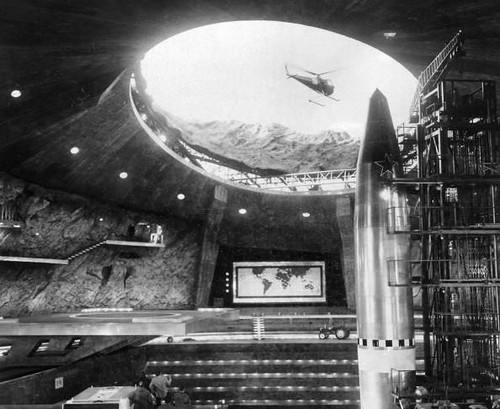
SPECTRE secret volcano base
Our secret volcano base. These are the kind of challenges you could expect during your new employment. This microfilm is for your eyes only.

Scientists and industrialists who feel that morality is relative and that the terms megalomaniac and elitist are often abused will enjoy preference for this once in a lifetime opportunity. Candidates will be flown to an exotic island location for selection and training. Candidates must love pets, especially Persian cats, and be immune to British accents. Maniacal laughter is a bonus. You must be willing to sign a non-disclosure agreement.

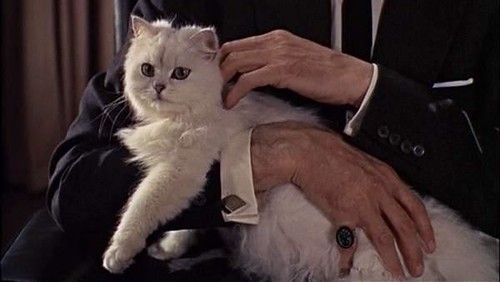
Ernst Stavro Blofeld, CEO of SPECTRE. He expects you to die, Mr Bond
Meet the boss: This is our CEO, Mr Ernst Stavro Blofeld. The cat is called Solomon. That's Mr Solomon to you.

Compensation: your share of $1 000 000 $100 000 000, negotiable. SPECTRE is an apolitical organisation. We are concerned with economics, not politics. A basic understanding of capitalism and anarchism would benefit you in your new job.

Contact Us


Number 1
Special Executive for Counter-Intelligence, Terrorism, Revenge, and Extortion
Post Office Box ****
Secret Volcano Base
****

14 November 2008

The Brain That Wouldn't Die DVD Review

Rating


horror film review top necro files blogspot

Conclusion


A horror film among horror films. It features everything a horror film needs to be great: from the paranoid and panicking violins to the sans-serif fonts. It even features buckets of blood, blonde strippers, brunette strippers, animated corpses and a few gratuitous boob shots. Well, as gratuitous as they came in the sixties. It even features suitable metaphors which provide social critique of the "chains we can believe in" society. The film is in black and white - like most of life, if you just do your homework and check your premises properly.

Plot


  • Jan Compton (Virginia Leith, who makes a delectable corpse) is decapitated in a car accident. Her husband to be, surgeon Bill Cortner (Jason Evers) was playing his Decapitated albums too loud and didn't pay attention to the road.

  • Dr Cortner is a mad scientist ala Lady Frankenstein who manages to keep Jan's head alive. I promise, no more Jan gave head in the car jokes.

  • Jan (or Jan in the pan, as she is affectionately known by fans of this film) goes through an existential crisis. I mean the poor girl thought she was going shopping and here she ends up without a body. I'm sure living without breasts she could cope with, but no nails to manicure? No wonder she starts hating Dr Cortner.

  • Dr Cortner decides to look for the body of the girl of his dreams for the girl of his dreams in the cat house. I'm sure it must've been a real catharsis for the poor guy, deciding to buy a body when he needed a body for Jan in the pan's sparkling personality. Besides, how is Jan in the pan going to stop him from having a night out with the boys? Well, Jan has her mysterious waves. Make that mysterious ways.

Brain That Wouldn't Die film poster Wikipedia top horror films reviewed reviews review

Review


It is alarming how, for its time, this film capitalised on the fears of the general public for the medical profession. Remember that this film was produced before the first heart transplant was even performed, yet it deals with swapping bodies - or swapping heads, depending on which way you look at it. I guess your perspective depends on whose head it is.

Regardless, with the expected technological singularity, there are a few groups who are beginning to ponder the impact of such a radical change on our concepts of what it means to be human. They fall under the blanket term transhumanists. One of the transhumanist movements is the Extropy movement. Jan in the pan would do well to pay mind to some of their ideas.

The principles of Extropy


  • Perpetual Progress: seeking more intelligence, more efficiency, more wisdom, more than being content with a shoddy pad, a big screen TV and free basic health care. Growth in healthy directions as opposed to the decline of civilisation from nations paranoid of communism into nations paranoid of capitalism.

  • Self-Transformation: improving oneself, through technology if necessary. Being experimental and proactive in your evolution as a person.

  • Practical Optimism: sticking to rational approaches means you can be optimistic about the results.

  • Intelligent Technology: because ultimately the industrial revolution was about improving life. To transcend our reliance on nature is divine and technology enables us to do so. Intelligent technology more so. Imagine never having a car accident because cars are intelligent enough to drive you home safely.

  • Open Society: meaning supporting social orders which facilitate freedom. This means deregulation, decentralisation of power and free information flow. Hackers like Gary McKinnon will no longer be deported to stand trial in foreign countries for taking his constitutional right of access to information seriously.

  • Self-Direction: meaning you determine your own happiness and you do what makes you happy without being coerced into any dubious overseas wars.

  • Rational Thinking: meaning you approach any ism with the necessary questions, an ability to work with probabilities and that you focus on innovation of new ideas instead of on the implementation of old dogma.

Of course, this all seems like ponies and rainbows, and in fact it is. I do think for Jan's sake, she should have considered these options before buying into the ideology that she is the ultimate horror. Everyone agrees with Bobby from pointlessbanter that Glitter is the ultimate horror. However, I'm also thankful that Jan did not follow the road less travelled to this fountain of knowledge, because that would make a far more boring film.

One of my favourite horror films of all time and fortunately also one you can download free of charge! Yes, it is legal.

Director
Joseph Green

Cast
Bruce Brighton, Jason Evers, Virginia Leith, Bonnie Sharie, Paula Maurice

11 October 2008

Pillar Perfect: Commentary on an irrational interpretation of anarcho-capitalism

one dollar bill burnt istock photo anarchy
This is a commentary on a post by a self-styled anarchist. You can find the entire post here: Pillage Perfect.

I have taken quotations from that page for commentary, much like I did for the tragically lacklustre Serj essay.


As it stands, my understanding is that Anarcho-Capitalists believe that no business shall be regulated by laws, however the Rule of Law would still apply to individuals.

As it stands, my understanding of anarchism is that nobody shall be regulated by a government. The free market is allowed to operate freely, because all affairs of man should be determined by the entities (be they individuals or businesses) concerned on a voluntary basis.

There is no clear definition of anarcho-capitalism used in this post - not even an outside link for reference. The closest to a definition this post gets is the above.

Contrast this definition with a standard definition of anarcho-capitalism, namely a society without any government where the free market rules. The private sector would enforce law. Note that natural law would still apply to both businesses and individuals. The differences are that the law industry is privatised and not ruled by a central monopoly like the state, and that economic practices are not artificially regulated.

Also note that the absence of government is precisely the scenario that anarchism suggests. Anarchism is defined as a society where government is abolished. To criticise Anarcho-Capitalism for not having a regulating agency like the government is to criticise the basic tenet of anarchy of any flavour.


History has shown us that businesses, corporations, land owners (the original "business owners" pre-capitalism), and the like are not, in fact, prone to ethical behavior. If they were, slavery would never have existed. Child labor would never have come about, and worker's rights would never have been an issue.


Capitalism is a system where property is privately owned and where the basic means of production is privately owned. For a business owner – original or not – to exist, capitalism is an a priori.

The original business owners pre-capitalism? That's a contradiction. There can be no business owners pre-capitalism, because owning a private business implies that capitalism is already established.

If one looks at the history of businesses, corporations and land owners, one finds no clear conclusion as to their propensity for ethical behaviour.

The Enron scandal is often sited as an example of the horrors of an unregulated market. This is nothing but an argument from ignorance. Picture a scenario where governments regulate markets absolutely. Would Enron be bankrupt today? No, of course not. They would still be up and running, with no stockholder any wiser as to their dirty tactics.

South Africa's Eskom is an example of the horrors of a regulated market, where competition is kept out and monopolies are kept in place by the divine rule of the government. In an unregulated market, Eskom would - just like Enron - be bankrupt today for exactly the same reason, namely selling commodities they did not have.

In short, having a massive corporation like Enron go bankrupt for not playing nice is an argument for deregulation, and not an argument for regulation. A company that doesn't deliver the goods should go bankrupt, like Enron did. A company that is friendly with the government does not go bankrupt in a regulated economy.

Slavery is a system whereby persons are deprived of personal freedom (including property rights) and forced to perform labour or services. Note that slavery is a pre-capitalist era practice. In fact, depriving individuals of private property rights is the first requisite for slavery to take hold. As a notion that brought about private ownership, capitalism actually brought the end of slavery.

Capitalism is not a system where human beings are held as property. Historically, big businesses and corporations never kept slaves. In fact, big businesses and corporations only came into being with a large dose of deregulation after the Industrial Revolution. Less government control gave rise to more individual autonomy, which gave rise to private ownership.

Slavery thrives in conditions where there are few land owners and a low level of technological development. This is precisely the kind of conditions which are a result of socialism. In African society, which has never been noted for its high level of private ownership nor its high level of technological development, African tribes such as Ashanti of Ghana and the Yoruba of Nigeria historically relied solely on slave trade.

Note that without a government, there would be no slave trade. The slave trade became established when slaves were captured and sold between African governments and their mostly Spanish and Portuguese counterparts. It is thus inaccurate to presume land ownership and slavery go hand in hand, as historically the exact opposite rings true.

In a society where you own the means of your productive capabilities and the means to sell them in a voluntary way, worker rights can never become an issue.

Of course, monopolies are good for the giant business that succeeds at crushing out the competition, but it is inherently bad for individuals, and yes, small businesses.

Not necessarily. A monopoly that is artificially kept in place is bad for everyone. Monopolies do however come and go when they are subjected to the laws of a free market, and by extension the law of supply and demand, as the Enron scandal showed.

A monopoly that is not regulated is actually good for individuals, and yes, small businesses, because of the resulting gaps in the market and because nobody can be kept out of the market by regulation.

There is a huge difference between a monopoly as part of a business cycle and a monopoly that is artificially created and kept in place by regulation. The former is inevitable and transient, the latter is artificial and leads to bad things like a credit crunch. Regulation doesn't solve business cycle problems, it only prolongs them and makes their impact worse.

Taxation is, actually, the largest group plan with the greatest group rate available. Regardless of your opinion about how budgets are made, and if we should have more say in how our taxes are used, you can't argue that the benefits of taxes give us the best bang for our buck.

You could, actually. We are agreed that artificial monopolies are bad? Then we have to conclude that a monopoly of taxation is bad, as it is monopolised by the government. We already established that private ownership leads to personal freedom and wealth. We already established that slavery is a state where your means of production is owned by someone else. How is taxation different? Does the end justify the means? That's like looking at the majestic pyramids and saying slavery is a good idea, because it gets results.

Anarcho-capitalism argues for private ownership of services like law and security precisely because it believes private ownership would greatly increase the efficacy of these services.

The main idea of anarcho-capitalism is to ensure that our governance becomes subject to the rules of perfect competition. This implies that we do not have one centralised government monopolising certain services, but many buyers and sellers who offer the same services, thus resulting in many substitutes for the government.


But who will pay for all of these services? You will! On a higher cost, single payer rate to a privatized company. Leaving the vast majority of people who cannot afford these services out in the cold, and with no access to programs that defend or protect their human rights.


Not exactly. We already established that competition is bad for monopolies, but good for us as individual consumers and small businesses. Instead of a government granting a tender to a company based on favour, tenders would be based on pure economic matters such as cost effectiveness and service delivery. Since there is no monopoly of your tax money and taxation is voluntary, the rates would actually go down (more competition, remember?).

Even if the rates go up, there would be more means to create wealth. In effect, escalating rates would have less effect on the average Joe on the street, because the average Joe on the street would be more wealthy.

Consider the state of the average Chinese person, where the government artificially keeps rates low, with the state of the average Hongkonger, who is largely subjected to the laws of the free market. The average Chinese person still can't afford the subsidised rates, yet the average Hongkonger can afford their largely exorbitant rates.

Since there is more competition, there would be more programs that defend or protect human rights. This means those who cannot afford these services in a monopolised system, would be more likely to afford them in a system with more competition – or start their own such systems!


To whom will the poor complain to about dangerous working conditions? To whom will the employees complain to about not being paid fairly, or at all? To whom will the workers turn to to stop exploitation? Will they complain to the company? Ha! The company will simply fire them, end of problem. Then what will they do?


This is based on several flawed assumptions. Some of these include:
  1. The poor necessarily have dangerous working conditions.

  2. Employees have no way to raise grievances in a system without regulation.

  3. Workers necessarily get exploited and companies will not hear these grievances unless they are required by regulation to do so.

Naturally, in a system with no regulation and thus more competition, for a monopoly to take root would be far more difficult than merely adhering to government regulation and getting on the good side of the one big monopoly.

Secondly, if a worker has grievances, such a worker has several other competitors for which he could work. Besides, we already established that an anarcho-capitalist system prescribes private ownership of property and the means of production – in other words, precisely the private rights that we are without in a centrally controlled or regulated economy. The law in such a system would not collapse, merely the system whereby the government determines law by its own decree and interpretation of the law.

Thirdly, since all workers privately own the means of their production and the fruits of their labour, exploitation can not occur without mutual consent. This is not the case in a regulated system, where you are often forced to belong to a labour union or pension plan against your will or better judgement. Again, the end does not justify the means.


Would this not then, put the corporations into the position of power known as the State? If they are creating, enforcing, and interpreting law, as well as controlling currency (and said value), creating and enforcing policies regarding individuals, does this not make the corporations a government by default?


It simply cannot, because there are no regulations which would grant sanctity or immunity to any one controlling agency. Any such a state would have to remain in place by remaining the most cost effective and delivering the best possible service for the price we as individuals are voluntarily contributing, amidst competition from other suppliers.

We have already seen that – contrary to the interpretation here – anarcho-capitalism is not about the abolishment of individual rights. Instead of promoting one agency to protect individual rights, anarcho-capitalists promote the competition of several such agencies to provide this service.

The poor will actually become poorer, and everyone knows that poverty breeds crime, so they will now be wide open for further victimization, by default. We had might as well close the poor communities in, and spray paint a giant bullseye and an "Open for Pillaging" sign on the walls.

Again, several flawed assumptions in this paragraph, namely:
  • The poor will become poorer.

  • Everyone knows that poverty breeds crime.

  • The poor will get pillaged by the wealthy.


The poor cannot become poorer. You can't take something away from someone who has nothing.

There is no direct link between socio-economic circumstances and crime. There is more evidence to suggest a link between innate intelligence and criminal activity, and broken homes and criminal activity, than between socio-economic circumstances and crime. Everyone simply does not agree on what causes crime and it is misleading to suggest this. It is mere speculation at best.

This paragraph suggests that the wealthy have nothing better to do with their time than to pillage the poor. It is suggested that the poor are lead to crime due to their socio-economic circumstances. If this were true, we would have to hold the converse to be true, namely that desirable socio-economic circumstances would completely get rid of crime. This implies that the wealthy – with advantageous socio-economic circumstances – would not be criminals. Since the wealthy would be the only class who is not inside the closed poor communities, they are the only class who would be in a position to pillage the poor. But then, the supposed cause of the criminal intent of the wealthy is non-existent, because they are in comfortable socio-economic circumstances.

I believe the contradictions are clear.

For all of the complaints about government restrictions on businesses, I read them while shaking my head. Let's look at these restrictions, minimum wage, any business complaining about minimum wage is an admission of guilt, of sorts, of wanting to pay employees less than the minimum amount.

This implies that minimum wage is determined objectively and fairly. For a business to complain about minimum wage is not an admission of anything.

In economies where labour laws are stringent, we find that it is more difficult to find work. This is the case in South Africa, were the desperately poor are not allowed to be hired legally by a business who honestly can't afford minimum wage. A bad job is better than no job. Minimum wages and labour laws keep a large contingent of people outside of the labour market.

If we look to history, what we see is that excessive poverty, plus excessive wealth equals market meltdown.

At what level does wealth become excessive? I can understand that any level of poverty is excessive, but certainly the precise definition of wealth as the state of having a plentiful supply of material goods and money implies excess.

This is actually an admission of guilt: labourers want a plentiful supply of material goods and money by virtue of the fact that they do not understand how someone who works smarter instead of harder is more wealthy. They see surplus, and they want some of that surplus, by nook or by crook. This is a logical fallacy based on the notion of positive rights.

In economics, excessive wealth is an amount of wealth that is accumulated by a person or group that goes so far above the normal amount of wealth it can no longer reasonably be used to purchase items, and thus, sustain an economic market. In other words, the uber-wealthy can only buy so many products, and when they stop buying products because they already have everything, their wealth becomes useless, thus excessive.

Yet more contradictions. In a society where the majority of people live in poverty and the minority is wealthy, any amount of wealth is above the normal level of wealth.

It is also a misnomer to suggest that money in the bank is useless or excessive. We all know how money in the bank contributes to keeping inflation low, because the money supply is down. Less inflation means that the poor do not become poorer (for lack of a better expression), because the value of their money doesn't drop. It follows that a society with the excessively wealthy is actually supporting those in excessive poverty, even if they never spend all their wealth, because they support the overall value of currency.

Historically speaking, those who earned unthinkable amounts of money on their own steam actually dispersed their wealth in reasonable ways before they passed away. Andrew Carnegie is perhaps the most famous example. Bill Gates is another such an example, as is his Microsoft co-founder Paul Allen.

If the poor don't have enough money to continue putting currency into the market, and the wealthy have nothing to buy, what you have is a market failure

Market failure results when optimal allocation of a resources is not attained. It is important to note the difference between optimal allocation and mere allocation as in sharing among everyone with a need for that resource.

In some cases, market failure is a result of minimum wages. Because employers are expected to pay x amount for wages, regardless of what the market demand for the performed labour is, we have a supply of labour without a demand for that labour. This is a market failure, because labour is a resource which is not allocated optimally. Labour is shared, as in allocated indiscriminately, without giving heed to supply and demand.

It is thus a misnomer that market failure implies that a resource like money is hogged by one particular group of a society, because the opposite does not necessarily imply optimal allocation of that resource. Market failure implies an allocation of resources which is not optimal, and has nothing to do with the wealthy with nothing to buy, or the poor with no money to spend.

Because of the law of supply and demand, the prices of goods and services would fluctuate. This means that such an equilibrium, where the poor have nothing to spend and the wealthy have nothing to spend on, is not an undesirable nor permanent state. It also does not imply a market failure.

Either that, or the people pushed into poverty will not try to "climb ladders" but rather stage a revolution, and put a stop to it, anyway.

And cause everyone to be poor. Revolutions like these merely put a stop to wealth, and not to poverty. The good kind of revolution is the kind that takes an economy away from centralised regulation towards a free market. The examples are too many to list. For recent examples, start with Poland and Ireland. For older examples, start with Germany and Austria.

Capitalism should never, under any circumstances, exist without the checks and balances of a State. Which is why Anarchists oppose both State and Capitalism, because the two are linked at the hip.

Actually capitalism and the notion of a state as a controlling enterprise are irreconcilable. To suggest that they are joined at the hip testifies of ignorance with regards to the role of the state and a basic definition of capitalism.

There is also a clear contradiction in claiming to be an anarchist, who calls for the abolishment of the state, and then calling for the regulation of an economic practice like capitalism by a state-like entity. The closest anarchism has come to answering this question is with the minarchism movement, which acknowledges that we do need a state. Kinda doesn't make it anarchy then, which explains why they called it something else.

"No gods, no masters. Against all authority"

While sloganeering like this is likely to impress Che Guevara fans, it is irrational to claim that capitalism should be regulated, then claiming that one is against any gods or masters or authority.

If capitalism is to be regulated, it implies an authority that could regulate it. What makes one an anarchist then, if one calls for such regulation? Isn't a capitalist by definition an anarchist?

25 August 2008

The Wicker Man

In ancient Celtic times, the wicker man was a large wicker effigy of a human being. It served as a scapegoat for all the ills of society, such as unwanted pregnancies, stillbirths, drought, warm beer and bearded women. Celts with their Black Sabbath Brummie accents and Asterix hats burnt the wicker man, thus ridding society of all its perceived ills.


The classic British cult horror, The Wicker Man (1973). Not to be confused with the retarded remake which starred Nicolas Cage (from the year that Cthulhu has cursed forever, for that very reason, 2006).

It worked to rid ancient England of its ills, because the villagers actually placed those who caused unwanted pregnancies, stillbirths, drought, warm beer and bearded women in the wicker man before they lit it. Whether those immolated with the wicker man deserved this or not, it certainly worked wonders to lower the amount of unwanted pregnancies and bearded women. When is the last time you saw a bearded woman? I rest my case.

Upon considering the wicker man and the classical logical fallacy of the straw man argument, one can't help but notice the similarities. I mean they're both effigies of men, made of straw (or wicker), and they burn.

The difference is that a real wicker man quickens the return of some men (and bearded women) to dust, while a straw man argument is a form of character assassination.

Here in Mzansi, we never had a wicker man. No, here wicker is far too useful for building shacks and filling the vacuum between your ears. We have a curious practice called necklacing instead. I'll spare you the gruesome detail. Suffice to say you better hope nobody comes knocking on your door when lightning strikes somebody.

I wanted to see either a wicker man or a straw man up in flames, if it's the last thing I did before Egoli. Well, it's currently winter here in a summer rainfall territory, meaning it's hardly necklacing season. I also haven't seen a bearded woman since the last time I went to the traffic department. Imagine my delight then when I found a straw man argument in the news.

"NP is back, itching for a fight"


The NP (the National Party) was the party of the 'architects of apartheid'. This fact is often pointed out by the ANC when they want to do a bit of character necklacing themselves. The fact that the NP was also the party of the architects of our democracy is not so often pointed out in these sessions. They don't serve to instill the sklavmoral, you see.

Regardless, this is not an instance where the ANC spewed forth their habitually obtuse drivel. Nay nay, this is a case where a journalist spewed forth ANC-like obtuse drivel. Of course, this is hardly surprising considering the innate affinity of those in soft sciences for sklavmoral, but damn it, I was looking for a straw man argument and I was going to see it proverbially in flames, immolated by necklacing, if it's the last thing I did before Egoli.

The nature of the yeast


Clearly, the author of NP is back, itching for a fight is brewing.
  • The piece is littered with ad hominem attacks which have more in common with infecting Sefrikans with ideology as opposed to being informative. Isn't the media supposed to trust Sefrikans to have the ideologically ideal equal brain capacity each human possesses to formulate our own opinions?

  • There are serious journalistic ethics and standards contraventions. There is no clear separation between news and opinion. Competing points of view are not portrayed in a balanced manner, nor are they characterised objectively. It's like a Polokwane conference.

  • The presentation is not in a standard, formal variety of English. This is due to the atrociously exaggerated improperly opportunistic use of adjectives.


After a bit of googling, I learned that the author is in fact a columnist. The piece originated as a column in its native Sunday Independent, yet it was syndicated as news for iol.

It is thus not the author who had been negligent, but the editors of iol who decided to present the opinion of a columnist as news against better judgement. All you disinformation conspiracy theorists, reach for your alarm bells. The time is nigh to wear those tinfoil hats.

Dic mihi solum facta, domina (Just the facts, ma'am)


Sticking to the facts, the piece would be much shorter. Next time, think of the trees, you capitalist pigs! This is the same piece, minus the adjectives, plus my own bias:
  • National Party spokesman Juan-Duval Uys was an employee of Cape Town councillor Badih Chaaban. Uys is no longer associated with Chaaban. In fact, Uys is currently a witness against Chaaban in an assault case.

  • The NP is well aware of its past racially based practices. It is trying to bridge the gap between the races by having a more demographically representative (yawn) membership and launching a youth group to appeal to more black people. The youth group is to be launched by disillusioned ANC youth (read: members of the ANCYL who haven't received a Model C-class Mercedes Benz yet).

  • The NP is well aware that the DA has become a refuge for former Natte who switched from wearing khaki to wearing Nigerian buba without realising that wearing Nigerian man dresses is not exactly showing your ethnic solidarity.

    Uys and his party are trying to win back the favour of these voters by claiming to implement non-racial employment policies once they come into power. I'm thinking they'd need bigger Mercedes Benz luxury vehicles if they're going to succeed with this one.

  • The NP is well aware that being associated with its Protestant Afrikaner past is going to be a stumbling block for many who adhere to different religious faiths. More specifically, the NP learnt from the blunders of the ANC that the majority of people want the separation of the church and state, or pay lip service to that noble concept at the very least.

  • Uys blames Marthinus 'used to be kortbroek but is now tree-hugging buba boy' Van Schalkwyk for proverbially floor crossing (read: taking the standard bribe of a Model C-class Mercedez Benz) to the ANC and disbanding the NP without consultation with the rest of the party members.

  • Black diamonds, the rising black middle class, who just like white Africans (read: colonialists in PC terms) my age did not grow up under apartheid and were largely unaffected by it and definitely not responsible for it, are disillusioned by the leading party's talk of revolution.

    Most of us are easy pickings to a party who manages to move away from ethnicity issues. The Anglophile black youth are more in tune with Y-fm and Usher than with the ANC and Stalin. They are unashamedly more skilled than their unskilled counterparts, they are unapologetically ready to make money and they rightfully feel that they don't need to rely on BEE to prove that they are worth as much as whiteys with degrees. Uys is trying to sway them to the NP side with his envisioned youth brigade and his talk of more realistic employment policies.

  • Uys is trying to cash in on the relative respect former president and Nobel peace prize winner F.W de Klerk enjoys. De Klerk should enjoy this respect for being integral to the transition from apartheid to a social democracy (read: serfdom that realises it needs to keep capitalists on a leash to feed the rest of the animal farm), but in reality de Klerk just has respect because he is associated with another former president, Nelson Mandela.

    De Klerk is evasive and weary about being associated with the Neo-New-National Party, but the link has already been forged in the popular press.


Why I will not vote for the NP


"On religion, the NP says it respects the practice of all, but will not tolerate Satanism."

That's like saying you're a non-smoker, except for menthol. As far as I am concerned, this dark Satanic anti-revolutionary legion is yet to be discovered. Of course, you get the odd Slipknot ninja, who is disowned even by Satanists for being an idiot. Next thing Uys is going to tell us that Rodney Seale is going to be the vice president once they come into power.

I am apolitical (libertarian at best), but I do feel that voting for any party except the ruling party at any point is a good idea to prevent a disproportionate amount of power in any party's court. We don't want a de facto single party state like the ANC has run into the ground for the past 15 years.
Jennifer Miller bearded lady woman
ANC apologists are quick to point out that we've had an impressive economic growth rate of above 4% for the past couple of years. They are not so quick to point out that in 1995, our GDP was 1 548 100. In 2005, our GDP was 1 523 254. For the period of 1995 to 2000, the average household income actually decreased. The GDP took a huge dump from 1995 and took until 2005 to recover. This means we spent an entire decade just catching up with what the minority managed to achieve all by themselves during apartheid.

We're not anywhere near actual growth. The key to surviving our public health system is not getting sick. We have a serious brain drain, just like the entire world apparently, but our skilled people are leaving to fix the entire world's problems because of our crime and our mampara BEE serfdom (which is bound to get worse if the Tzars of the ANC implement their Hugo Chavez-like nationalising of privately owned property as per the proposed expropriation bill).

Because they retain their skilled people, other emerging economies like China, India and Brazil are riding the wave of the global recession while South Africa is still following the white rabbit after the tired 'rich get richer while the poor get poorer' sloganeering down the socialist dream world rabbit hole.

How can the poor get poorer? They're already rock bottom poor. You can't take nothing away from someone.

From what I've seen, the NP are committed to rectifying these wrongs. They are making a big splash in a small pond, but they are hardly offering anything that other opposition parties like the DA, IFP or the UDM aren't offering already.

The difference is that the DA and the UDM would allow me to be a Satanist if I really wanted (as does our wonderful constitution). If you're going to have an effective group, you're going to have to live with views you don't agree with.

"A free society is one where it is safe to be unpopular." - Adlai Stevenson

In other words, a free society is a society without the wicker man. Now if there were a political party with a bearded woman, they'd automatically get my vote!

21 August 2008

Why we still need chauvinism

This is part three of "A field guide to Chauvinism". You may find the other parts here:
  1. A field guide to chauvinism, part 1

  2. The conquering archetype and the nurturing archetype, part 2.

  3. Why we still need chauvinism, part 3.

  4. The singularity age, part 4.

Why we still need chauvinism


  1. In times when our survival as a species is threatened, the conquering archetype deals effectively with the conditions determined by natural selection (survival of the fittest). In times when our survival is not threatened, the nurturing archetype introduces genetic drift.

  2. Chauvinism preserves strains of both conquering and nurturing archetypes in any society in case we may need them to advance to the next wave of civilisation at some point.

  3. We are currently in Toffler's third wave, the information age. Since each age followed more quickly upon its predecessor, the fourth wave is bound to follow sooner upon the third wave than the third wave followed upon the second wave.

  4. When any given archetype becomes so overwhelmingly dominant that it causes a group to become ineffective, it is time to start talking about the next revolution to favour optimal wisdom of crowds.


Sabre tooth tiger display at the Smitsonian Institute
A sabre tooth tiger. Grrr, baby!

Natural selection and genetic drift


Natural selection is the process whereby desirable traits become more widespread in a population and undesirable traits become less common. It's the process that caused the slow runners to be eaten by sabre tooth tigers in the hunter-gatherer era, while fast runners were not. This meant that by the time of the agrarian age, everyone could more or less negotiate their way around sabre tooth tigers thanks to latent running talents.

It is the same process that causes smarter people to make more money than dumber people during the information age despite all the socially conditioned equality and virtually equal access to information. This drives the specialisation of a population, resulting in populations of mostly fast runners or quick thinkers, provided that the slow runners and the slow thinkers are prohibited from splashing in the same gene pool.

Eugenics was an ill-fated attempt at formalising what mother nature already inevitably does when our survival is threatened. Natural selection takes care of the slow runners and the slow thinkers, thus ensuring that subsequent generations are faster runners and quicker thinkers.

Genetic drift is the process whereby traits are merely randomly distributed without any apparent favour. In times when our survival is not threatened, it is not that easy to distinguish between desirable and undesirable traits. This is why eugenics failed miserably the first time around. Think of quick runners. Is it currently desirable to be a quick runner? That's arguable to both sides, with no clear conclusion.

Genetic drift is currently the overwhelming evolutionary process in the majority of the human species. We're not making progress here, we are mostly treading water for as long as our environment allows everyone an opportunity to run, regardless of talent or skill.

When our survival is not threatened, the nurturing archetype tries to preserve as many possible traits as possible, which is sensible. I mean you never know when those pesky scientist might find the DNA of sabre tooth tigers in amber and we need to start running again.

Chauvinism preserves the less dominant traits for when we may need them


During the agrarian age, it was technically no longer required to be a fast runner. You could effectively work a field of crops with slow moving child slaves, as the Children of the Corn demonstrates. Yet we are now running faster than ever before. If it weren't for chauvinism which dictated the preservation of the allele that causes fast runners without any clear purpose, we would have channel surfing as an Olympic event. Homer Simpson would be the reining champion, while also taking home a gold medal in beer guzzling.

Similarly, there are still male chauvinists and female chauvinists, even though their time has come. Yet male chauvinists tend to be far more successful at sleeping with the enemy than their female counterparts, thus ensuring that a male chauvinist streak will be preserved, for no apparent reason. This while female chauvinism is systematically being ridiculed and rooted out, also for no apparent reason other than the relatively established socially conditioned notions of equality and the population shrinkage of the more advanced nations.

This begs the question why male chauvinism tends to be biologically favoured, despite the noble efforts of the female chauvinists to eradicate it once and for all. Perhaps looking at the succession of the waves of civilisation and the overwhelming archetype in each wave would answer this question.

The pattern of revolution


Each wave of civilisation requires the dominance of a certain archetype, namely either conquering or nurturing. This dominion is established each time by a revolution which goes against the grain of the dominant archetype of its age.

  • Hunter-gatherer societies required dominion of the conquering archetype. Fast running, accurate spear lugging and as little knuckle dragging as possible. You go, girls!

  • The agrarian age required dominion of the nurturing archetype, which was achieved by the agrarian revolution. Women stopped growing beards because it freaked out the kids. Kids were taught how to pick berries and how to grow them instead of just chasing after more furry vermin.

  • The conquering archetype was required for the industrial age, and it came into power thanks to the industrial revolution. Facial hair continues to recede, with mutton chops and handlebar moustaches being the order of the day. Bearded women continue to be victimised and usually end up as freak show attractions, except in Greece and Portugal.

  • The information age is a consequence of the information revolution, which was brought about by a nurturing archetype. Social conditioning dictates that even body hair is now taboo. It becomes exceedingly difficult to distinguish between men and women, with biology taking a back seat to the chosen affirmations of the individual.

    You can even get chopped off and sewn across if you are a guy. If you are a girl, you can get an adadictomy. In extreme cases, the state even pays for your operation but it refuses to foot the bill of the years of therapy your disillusioned parents would require, because they are merely being overly conservative.

  • It appears that the fourth wave (which I would call the singularity society) would result from the dominance of the conquering archetype achieving dominion once more. This despite the socialist utopia offered by the authors of The Fourth Wave: Business in the 21st Century. If you really need another lesson in environmentally responsible economics, try Buddhist economics. It acknowledges the human component without the Marxist drivel.


Alvin Toffler's waves of civilicastion with an added fourth wave added, namely the singularity age

The pattern of the revolutions which lead us through the ages of development of society. As you can see, it's a highly scientific graph.

The times they are a-changin'


How does mother nature determine when it is time to switch archetypes? It would appear that the situation presents itself when a group is no longer capitalising on the wisdom of crowds (which I described in my review of Curse of the Devil). In other words, when a group starts exhibiting the following behaviour traits:
  • The diversity of opinion in a group is no longer encouraged. Individuals are no longer allowed to differ from the group. You may no longer write 'he' when you mean a person without a lengthy explanation that you aren't a sexist at the beginning of your book, despite the agony this causes to the rainforests thanks to the trees required for the extra printing.

  • Independence is discouraged. The institute of the state is no longer even questioned. Death and taxes are deemed as unavoidable realities we have to face, come hell or high water or corrupt politicians. We are not conditioned how to think, we are conditioned what to think. You try to explain the benefits of eugenics to random people you meet on the street. If you survive, you are clearly a fast runner.

  • Centralisation which does not allow for the specialisation of knowledge. This was a particular weakness of the church during the dark ages, which meant the slow thinkers were kept slow since they were never challenged, the fast thinkers were silenced since they were antagonising sanctified opinions and homosexuals are to this day barred from church despite all the spin to the contrary. This is not a mantelpiece of an era gone by. There are still superstitious cretins who try to make evolution out to be some theory on par with more sensible biblical explanations of biological diversity.

  • No clear aggregation of knowledge. Information needs to be useful, and we need a standard to judge its utility. To me, this parallels Ludwig von Mises' criticism of socialism, which you can read about in my review of Nile's Black Seeds of Vengeance.

    Lacking a free market, a socialist system has no clear method of measuring the needs of a society or measuring the performance of its services. Catering for a broadly defined average results in a general collapse of standards instead of an overall upheaval.

    I feel that a free market and the associated meritocracy it implies are sufficient standards to aggregate virtually every aspect of society. More importantly, such a meritocracy would dictate the dominance of the appropriate archetype for each wave of civilisation without the senseless bloodshed.


The woman's movement did not put an end to chauvinism


And if it did, our species would end as soon as we reached the next revolution that requires a dominant conquering archetype.

Paris Hilton arguably deserves credit for her marketing abilities, but ultimately she's famous for being famous. More precisely, she's famous because her tits and ass appeal to male chauvinist notions of female qualities waiting to be conquered.

Image of Paris Hilton naked? No. Paris Hilton is glamorously dressed for a change.
Paris Hilton naked. Oh, my bad. Paris Hilton with clothes on for a change.

The disdain, envy and jealousy she inspires in womanists, radical feminists and less noticeable fellow women are almost as vitriolic as the sweating and drooling she inspires in chauvinists of the male variety. These male chauvinists are refugees from the days when a night out with the boys consisted of raping and pillaging the nearest neighbouring village.

It is thus clear that the film 300 is not only about an ethnically pure group resisting integration into an ethnically diverse group, much like ethnically pure China is resisting attempts from the ethnically diverse West to globalise everywhere with the smell of oil, but also about the preservation of the conquering archetype by means of chauvinism.

Nobody could deny that the dominance of male chauvinism was required for the people of Sparta to resist the Persian invasion by Xerxes. By the same token, nobody could deny that if they employed their nurturing instincts, there would have been far less immediate bloodshed. However, if they and everyone who ever reached a challenge to their instincts merely gave way to the overwhelmingly popular opinion, we'd all be living in one of Stalinist Russia, Hitler's Nazi Germany, Eisenhower's America or Mao Zedong's communist China by now. While the immediate bloodshed would have been less, the total bloodshed would have been far greater.

What does the fourth wave entail?


In conclusion, it seems that our current society is treading water in the third wave. Granted, the nurturing archetype was necessary for the third wave and the woman's movement did a great job at nurturing it, but it is time to start thinking about what the fourth wave would entail. Judging by the biological shenanigans of the male chauvinists and the pattern of domineering archetypes we've had so far, we could assume that the conquering archetype would be effective in bringing about the next revolution.

In the next chauvinist post, I will draw inspiration from Timothy Leary's 8 circuit model of consciousness, thoughts on technological singularity and a deck of Tarot cards to predict the fourth wave. Hopefully without having to clone sabre tooth tigers.

08 July 2008

Babes and badasses: Review of Black Seeds of Vengeance by Nile

Cover for Nile's Black Seeds of Vengeance

Conclusion


In terms of being badass, Nile is one of the most innovative technical death metal bands. Each track is characterised by sheer brutality or ingenuity. This is their second album and it is a bit fractal, but if you know Nile well it is still worth listening to get to know their roots. Plus you can never go wrong with Derek Roddy on drums.

Review


"Libation Unto the Shades Who Lurk in the Shadows of the Temple of Anhur" evokes ancient Egypt in the mind's eye. This track features an acoustic guitar, lusciously recorded with multiple microphones inside a stone chamber underneath the recording studio to capture real reverb.

Anhur was originally a foreign war deity, characterised by a robe and the four feathers in his head dress. Shu, the Egyptian concept of sky, also had four feathers in its head dress. Anhur also means sky bearer. It is thus not surprising that Anhur and Shu later became merged to form Anhur-Shu. No prizes for guessing where that name came from.

Anhur
Anhur, as portrayed on this site.

In the time of the New Kingdom, Anhur became known as a saviour. This is because people viewed war as the source of their emancipation from human burden. Freedom and victory were seen as a direct result of war. If you consider economics as a kind of warfare, with capitalism as the source of freedom and victory achieved over the human burden, Ludwig von Mises can be seen as a saviour and the earthly embodiment of Anhur. Socialism can then be seen as largely concerned with sharing human burden instead of combating it. In this view, capitalism is regarded as the war against socialism, and socialism is regarded as human burden.

Socialism considered here refers to an economic system where the means of production are owned and controlled by the government. No private land ownership is allowed. A definition of communism is a system with the credo: From each according to his ability, to each according to his need. For the purpose of this discussion, no distinction is made between communism and socialism.

The definition of capitalism considered here refers to an economic system where the means of production and the distribution of goods are owned and controlled by private ownership. In such a system, the only exploitation could thus result from the private owners themselves. Laissez faire capitalism, with minimal or no state intervention, is the preferred definition for this discussion.

In such a system, to claim that any person who benefits from capitalism is exploiting someone else is as short-sighted and far fetched as claiming electricity is evil because people get electrocuted. Just like with electricity, the benefits of capitalism far outweigh the disadvantages, but don't take my word for it. Take the word of Ludwig von Mises for it.

Ludwig von Mises
Badass capitalist Ludwig von Mises. He should really be wearing four feathers in a head dress.

Economic calculation problem


Socialism leaves many unanswered questions. Ludwig von Mises identified some of these with his criticism of socialist economics. A few key concerns addressed by capitalism which are not adequetly dealt with by socialism include:
  • comparing heterogeneous goods

  • relating utility to capital and consumption of goods

  • entrepreneurship needs a pay-off

  • coherent planning for production without economic stimulus

  • financial markets need a way to guide capital investment in order to avoid economic depression


Disadvantages of socialism


  • Socialism has no objective way of comparing heterogeneous goods, never mind services. How many fish go into a haircut? How many potatoes are a fish worth? What about a house? How many fish would you need to catch in order to barter for a house? What if the house builder is vegetarian? Clearly, a barter system is not without its shortcomings. Perhaps this is why a currency developed in primitive societies in the first place.

  • Marxist theory argues that labour content serves as a means to value goods (labour theory of value). This is absurd, as a plastic chew toy from China arguably has very little labour content if it were made in a factory with very low labour intensity. Similarly, in a rationing system, there is no objective way to rate the consumption of goods or the suitability of those goods. How do you rate consumer satisfaction if the consumer does not have the ability to choose with his money?

  • Entrepreneurship needs a pay-off. It is widely accepted that entrepreneurship is crucial to economic development. If you follow the credo of from each according to his ability and to each according to his need, someone like Bill Gates would have no incentive to identify a window of opportunity in the market and then figure out a way to exploit it. Why should he, if he would get according to his need?

    Nobody needs a company worth billions of dollars, except (ironically) the millions of starving people who rely on charity. It is thus not accurate to presume that the millions of starving people are getting exploited by Bill Gates and other capitalists. The truth is it is the other way around. Millions of starving people are exploiting the capitalists, because the capitalists are losing out whenever they make a donation to charity. Of course, if the millions of starving people could be trained to take part in the economy, that is to become capitalists themselves, it is a win win. They would be producers and consumers, instead of only being parasitic consumers.

    As an aside, in terms of labour theory of value, how much would a million dollar cheque from Bill Gates really be worth? Thousands of people performed labour for that cheque. Is it really fair to give that labour away?

  • Coherent planning for production without any economic stimulus would rely on the expert opinion of a few who were appointed by the government to make sure everyone remains the lowest common denominator. You should really not catch more fish than what a potato is worth, despite the fact that you can't account for the weather, potato blight or low fish levels. In a socialist system, you can't even do the accounting for that.

  • Financial markets need a way to guide capital investment in order to avoid economic depression. You can't view wealth as a pie that needs to be divided among everyone. Everyone did not help to bake that pie. Those who are not economically active need to find a way to become economically active. It is not true that you are entitled to a job or entitled to an amount of wealth. If you had a sack of potatoes stored and your community hits a drought, but you weren't actually allowed to store potatoes for yourself, would it be fair to share those potatoes at your expense?

Naturally, this is a very biased rant against the evils of communism. Let's just say I would rather live in my own house in Africa than in the government's house in the USSR. Speaking in terms of communism, if the Spice Girls sold more than 23 million records and Nile needs to sell 1 million records to make ends meet, then surely the Spice Girls should buy a shit load of Nile albums. Now in theory that's not a bad idea at all, but in practice, if you had a socialist system, where would that money ultimately originate? How would the Spice Girls sell 23 million records if each person can only afford to buy one album? Would a band like Nile even exist in such a system, where choice is so limited? What would the Spice Girls do with a million of the same album?

The Spice Girls
The Spice Girls. The Marxist labour theory of value dictates that since the Spice Girls can hardly play any instruments, and Nile can play their instruments at near virtuoso level in their genre, each Spice Girl has to buy about a million copies of Nile's Black Seeds of Vengeance. Don't worry, it makes no sense to me either.

You can get a more balanced account of the entire argument on the Wikipedia page of the economic calculation problem. If you really want to feel your brain get smaller, read the counter arguments and notice how piss poor they are. Especially with regards to the surprising accuracy of prediction markets and supposedly the empirical evidence they bring along with them. Oh yes, not to mention that the USSR could not sustain itself while Hong Kong is a decidedly more advanced place to live.

Clearly, Nile's music just makes me angry. The Egyptian flavours in their lyrics just remind me that socialism is trying to reinvent the wheel when we are already conceptualising time travelling.

William J.H. Boetscker's Ten Cannots (not so common sense)


  1. You cannot bring about prosperity by discouraging thrift.

  2. You cannot strengthen the weak by weakening the strong.

  3. You cannot help little men by tearing down big men.

  4. You cannot lift the wage earner by pulling down the wage payer.

  5. You cannot help the poor by destroying the rich.

  6. You cannot establish sound security on borrowed money.

  7. You cannot further the brotherhood of man by inciting class hatred.

  8. You cannot keep out of trouble by spending more than you earn.

  9. You cannot build character and courage by destroying men's initiative and independence.

  10. And you cannot help men permanently by doing for them what they can and should do for themselves.


Track listing


  1. Invocation of the Gate of Aat-Ankh-es-en-Amenti

  2. Black Seeds of Vengeance

  3. Defiling the Gates of Ishtar

  4. The Black Flame

  5. Libation Unto the Shades Who Lurk in the Shadows of the Temple of Anhur

  6. Masturbating the War God

  7. Multitude of Foes

  8. Chapter for Transforming into a Snake

  9. Nas Akhu Khan she en Asbiu

  10. To Dream of Ur

  11. The Nameless City of the Accursed

  12. Khetti Satha Shemsu


Personell


Mostafa Abd el Aziz: arghoul.
Aly et Maher el Helbney : respirations on "The Nameless City of the Accursed".
Mohammed el Hebney: additional chants on "Khetti Satha Shemsu".
Peter Hammoura: vocals, additional drums.
Derek Roddy: drums.
Karl Sanders: vocals, guitar.
Dallas Toler-Wade: vocals, guitar.

Rating


rating skulls top heavy metal albums on the necro files

Google sucks piles I'm moving to Steemit

Short and sweet, Google isn't allowing me to post ads on my blogs here on blogspot any longer. Not that I provide my angry nerd rants fo...