Moved to Steemit. Read it here:
Russell Brand and the Messiah Simplex
Showing posts with label economics. Show all posts
Showing posts with label economics. Show all posts
24 December 2014


16 February 2013
The Resource Based Economy mind virus
We've seen the Zeitgeist films and sadly they're still taking a hold on impressionable young minds that could be doing something useful instead. Despite its shoddy research, its baseless assertions and its gross generalisations (or perhaps because of them), a few things about the films stand out:

Here's an image of Frank Zappa. Because Zappa is god.
Let's picture a world without money to highlight why there is money in the first place: If all we have are commodities without a currency to mediate, we are reliant on the coincidence of wants. To simplify the point, let's forget all the other complications such as a lack of a store of value, a lack of a unit of account, a lack of a standard for deferred payment, and all the other benefits that money gives us. Let's just focus on the coincidence of wants.
Suggest that you are a dental floss salesman from Montana. You go to the dentist. Your dentist is already well-stocked when it comes to dental paraphernalia and he does not require more dental floss. You are living in a society that has been exorcised of all money. How do you pay for your dentist visit?
This is perhaps why some anthropologists claim that debt is the first instance of money. Maybe some barterers got sick of getting the same goods from the same people and just said let's stick to I.O.U.s. Just like Menger's original account of where money originated, this is pure speculation and the functions of money do not rely on the order of things. It does however show two things:
Before we get to the Venus Project, it is worth noting what economics is. Economics is a social science primarily concerned with the production, consumption and distribution of resources. A Resource Based Economy thus refers to an economic problem per definition. Any notions that a Resource Based Economy is a radically new idea are thus misguided and testifies plainly of ignorance of economics as a field.
The Zeitgeist evangelists are familiar with the term as a reference to a system where information, goods and services are freely available. Their Resource Based Economy (RBE) relies fundamentally on the "average man" - a notion that first inspired the Socialism and Communism from which Zeitgeist bildungsphilisters are trying to separate themselves at all non-monetary costs.
This begs quite a few questions:
The dangers of this system are not contained in its misguided calls for getting rid of currency, but in its social engineering implications. Social engineering is nothing new: It has been tried and tested and it doesn't work. The reason why it doesn't work is because the needs and wants of a group of individuals cannot be accurately portrayed by merely averaging out their individual whims and conveniently ignoring the outliers. Many of the brightest, most highly qualified engineers have tried, and failed. This is nothing but the principle of 'from each according to their ability, to each according to their need' in denial and in disguise.
Is it a good idea to unravel all the gains of the Age of Enlightenment to return to a serfdom? Except now it's an improvement because of social engineering, scientific socialism, and the consolement that the serfdom is run by the same kind of bots that crashed Wall Street?
- We have to get rid of all monetary systems.
- The answer to all our woes is a Resource Based Economy.

Here's an image of Frank Zappa. Because Zappa is god.
Why should we get rid of a monetary system?
The Zeitgeist films try very hard to blame all our current problems on a monetary system. This is probably because the Zeitgeist movement conflates a fractional reserve banking system with monetary systems everywhere. Most people are economically illiterate and the notion that money is the root of all evil is not exactly a hard-earned conclusion."Money is a matter of functions four, a medium, a measure, a standard, a store".
Let's picture a world without money to highlight why there is money in the first place: If all we have are commodities without a currency to mediate, we are reliant on the coincidence of wants. To simplify the point, let's forget all the other complications such as a lack of a store of value, a lack of a unit of account, a lack of a standard for deferred payment, and all the other benefits that money gives us. Let's just focus on the coincidence of wants.
Suggest that you are a dental floss salesman from Montana. You go to the dentist. Your dentist is already well-stocked when it comes to dental paraphernalia and he does not require more dental floss. You are living in a society that has been exorcised of all money. How do you pay for your dentist visit?
This is perhaps why some anthropologists claim that debt is the first instance of money. Maybe some barterers got sick of getting the same goods from the same people and just said let's stick to I.O.U.s. Just like Menger's original account of where money originated, this is pure speculation and the functions of money do not rely on the order of things. It does however show two things:
- Without money, we still need a coincidence of wants. This coincidence of wants presents an unsolvable problem. To be more succinct, it is impossible to please everyone.
- The Resource Based Economy relies on commodities and conveniently ignores services that are provided by skilled people. This is perhaps because its chief evangelist is not a trained engineer and is unfamiliar with the kind of perseverance it takes to become skilled in a discipline. The Resource Based Economy just assumes we'd all be happy to get our daily bread from spambots and go on our merry way while automatically just obtaining the kind of skills required to maintain the spambots. If this is the case, why is there such high incidence of crime amongst people on welfare who do have the bare minimum that anyone could ask for given to them? But I'm getting ahead of myself, let's see what an RBE is.
What is a Resource Based Economy?
Before we get to the Venus Project, it is worth noting what economics is. Economics is a social science primarily concerned with the production, consumption and distribution of resources. A Resource Based Economy thus refers to an economic problem per definition. Any notions that a Resource Based Economy is a radically new idea are thus misguided and testifies plainly of ignorance of economics as a field.
The Zeitgeist evangelists are familiar with the term as a reference to a system where information, goods and services are freely available. Their Resource Based Economy (RBE) relies fundamentally on the "average man" - a notion that first inspired the Socialism and Communism from which Zeitgeist bildungsphilisters are trying to separate themselves at all non-monetary costs.
This begs quite a few questions:
- Where do these skills and services come from? The information content of virtually any tertiary education is already freely available (see Khan Academy for one), but this has not yielded the masses of skilled semi-professionals that it could have yielded. By contrast, voluntary free association has yielded many fruitful projects, amongst them Wikipedia and SETI@home (and no, these are not examples of gift economies, these are examples of Collective Intelligence).
- What about people who prefer having more of a given commodity than is provided by the spambots? We are told that the Venus Project does not rely on bartering or on a monetary system. What if I like hoarding chickens and I end up with more chickens than anyone in the Venus Project? Are the spambots going to dish my chickens out to all and sundry, in which case I have no more incentive to keep them in addition to experiencing the tyranny of social engineering first hand? What if my chickens require more land than my allocated land? Will the Venus Project assure me the property rights to enlarge my coop, or will I have to conduct a chicken coup d'edat? Death to the naked apes! Power to the flightless birds!
- How does this system deal with scarcity? Some commodities are in fact scarce and this is more or less reflected in their monetary value, give or take a few hiccups. If we share scarce resources equally, we'd all be fitted with essentially a pittance of that resource that is of no use to anyone.
- How does this system prevent bartering, trading and all the other innately human impulses that give rise to inequality in the first place?
The dangers of this system are not contained in its misguided calls for getting rid of currency, but in its social engineering implications. Social engineering is nothing new: It has been tried and tested and it doesn't work. The reason why it doesn't work is because the needs and wants of a group of individuals cannot be accurately portrayed by merely averaging out their individual whims and conveniently ignoring the outliers. Many of the brightest, most highly qualified engineers have tried, and failed. This is nothing but the principle of 'from each according to their ability, to each according to their need' in denial and in disguise.
Is it a good idea to unravel all the gains of the Age of Enlightenment to return to a serfdom? Except now it's an improvement because of social engineering, scientific socialism, and the consolement that the serfdom is run by the same kind of bots that crashed Wall Street?
26 August 2012
Money versus 'Resource based economics'
There's still mass confusion ruling in the midst of the Zeitgeist movement and the Venus Project zealots. The Zeitgeist movement thinks we do not need money because a fraction of the monetary system we currently have is fractional reserve banking, while the Venus Project thinks it's easy to do a bit of finely tuned central planning and cater for everyone's subjective evaluation of goods and services. Here are some basic questions about money that I tried to answer:
Highest marketability merely means that everyone is happier when you pay them in money than when you pay them in eggs. On your egg farm, your workers will be happier when you pay them in money than when you hand them a tray of eggs for a day's work. In turn, you can get eggs with money, but you can't usually trade eggs for something else in the barter or direct exchange way.
A store of value means you get a bit more time to decide what you'd like to trade. This means you aren't limited by how long your eggs stay fresh in order to make purchases in the direct exchange/barter way, but you can shove all the money under your mattress for a rainy day.
As you can see, our current system separates the basic economic principle of exchange from money entirely. In short, 'let them eat credit'. You don't exchange your eggs on your egg farm for a car with money serving as a convenient medium of exchange. Instead, your car is usually bundled with financial services, guarantees that you won't default, monthly instalments and insurance to the extent that it's more about currency than exchanging goods and services for other goods and services.
For this reason, amongst others, the Rothbards of the world believe we should stick to an objective standard for money. The first known cases of money did this, with measures of silver equal to a certain amount of grain. Which leads us to your next question:
The exact material used for money depends on many factors. In history, the most common denominator is usually some precious metal, like gold. This is because it is scarce, its purity can be determined objectively and it can be weighed objectively, so it serves as a standard. I still think we should use beer as our currency. Often, people were not happy with the authorities meddling with the purity of commodity money, which brings us to:
How is money generated?
Money is a medium of exchange. It is generated by manufacturing it, just like any other product. Unlike any other product, money (as in currency) has the highest marketability and serves as the greatest store of value. Any currency has to have these 2 properties. I'll illustrate this with an egg: Suggest that you are an egg farmer.Highest marketability merely means that everyone is happier when you pay them in money than when you pay them in eggs. On your egg farm, your workers will be happier when you pay them in money than when you hand them a tray of eggs for a day's work. In turn, you can get eggs with money, but you can't usually trade eggs for something else in the barter or direct exchange way.
A store of value means you get a bit more time to decide what you'd like to trade. This means you aren't limited by how long your eggs stay fresh in order to make purchases in the direct exchange/barter way, but you can shove all the money under your mattress for a rainy day.
As you can see, our current system separates the basic economic principle of exchange from money entirely. In short, 'let them eat credit'. You don't exchange your eggs on your egg farm for a car with money serving as a convenient medium of exchange. Instead, your car is usually bundled with financial services, guarantees that you won't default, monthly instalments and insurance to the extent that it's more about currency than exchanging goods and services for other goods and services.
For this reason, amongst others, the Rothbards of the world believe we should stick to an objective standard for money. The first known cases of money did this, with measures of silver equal to a certain amount of grain. Which leads us to your next question:
What conditions exist when this money is created?
It varies. Money as in a medium of exchange is usually created whenever you have something that I value and I have something you value, but we don't value them equally and we find something that has a higher marketability and serves as a store of value. This could be anything, from the Roman Empire's silver coins (which served as currency as far as India and existed side-by-side with bartering), to cowrie shells, which was the currency of choice in Africa for hundreds of years. By the way, cowrie shells also cast doubt in the notion that there is no empirical observation of currency taking root, besides the fact that debt is also currency.The exact material used for money depends on many factors. In history, the most common denominator is usually some precious metal, like gold. This is because it is scarce, its purity can be determined objectively and it can be weighed objectively, so it serves as a standard. I still think we should use beer as our currency. Often, people were not happy with the authorities meddling with the purity of commodity money, which brings us to:
Who owns the 'right' to create money?
Everyone does. At least that's the ideal of people like Friedrich Hayek. This also happens whenever a certain currency is inflated to such an extent that its marketability is no longer more significant than something else, like the Zimbabwean Dollar that was neglected in favour of American Dollars, or mobile phone credit that is used as currency in Iraq. It's also the idea of bitcoin and other newer versions of digital currency. In reality, the authorities keep a tight grip on money creation as it's easy to launder money, in which case they lose out on taxes, or to counterfeit money, in which case we may be defrauded.
What purpose does interest serve?
Without interest, money lenders have no incentive to lend to those who need money. This is an awkward position for many small businesses and the poorest of the poor, many of whom are women in impoverished communities building businesses with loan shark money. I'd think interest serves everyone's interests.
Without currency there is no economy!!!! So why are we not taught about currency and the creation thereof?
I'd take that one step further: Without currency, there is no civilisation. We live in the information age, where we are quite capable to teach ourselves nearly anything we'd like to know. We do have currency so going back to a stage where we no longer have currency is not progress, it's regression. If anything, we'd have to invent and embrace the next stage of our evolution. In other words, build the future.
19 February 2012
For Whom the Bell Curve tolls
I've been procrastinating with debates of a rather dismal level. Some of my trolling efforts may be witnessed at the Occupy South Africa or Operation Ubuntu facebook page. It turns out there are a handful of dyed in the wool NOT reds who are spawning Occupy protest pages at a rate that would almost have gullible people believe that there's a massive uprising in the country.
From one of the commentators:
Direct Democracy is a socio-political element, Distribution is a socio-economic concept. Distribution is a seperate concept to that of Direct Democracy. Currently the distribution of resources cannot exceed the capacity. But current distribution is far from equitable, hence some have far more and others have none. The imbalance in distribution is caused by the system deployed to bridge individuals with resources. The current system is a one size fits all system with salaried employment, or profit motive at it's core. We are proposing a new resource distribution system in which the actual requirements of individuals is the determinant, from a base of acceptance that all humans have equal claim to all resources. Don't confuse the system of distribution with the system of decision making and planning.
The obvious apprehensions are:
It appears that income inequality is one of those things that causes people to yearn for a bed of Procrustes scenario whereby any loose ends are chopped off and piled on the big general resource pile to ensure a more equitable distribution. Most of the movement appears to put great stock in the labour theory of value, so why would anyone want more currency that is already decoupled from an underlying commodity like gold, beer or labour? These grievances aside, I poked some fun with a reply:
All humans do not have equal claim to all resources. For example, I do not have equal claim to the grapes growing on Rondebosch wine farm than the next bergie has.
I also have no need for kiddie seats in restaurants, wheelchair access ramps, ATMs where I have to duck or the warnings on coffee containers that the contents may be hot.
At first, this was perplexing, but I soon realised being hot is just one of those things that one could expect when one orders a drink that ordinary is served with a temperature on the tall and thin side of the thermometer. Clearly, there is a great deal of inequity in this world that goes beyond mere income distribution or access to resources.
Pray tell, which god may we thank for the greater glory of the auto-mobile seat belt and would you duct tape one to every rattling public transportation device? What if I've voted in a directly democratic system that I think seat belts are a terrible idea and we should neglect them to cull the herd so the aggregate of height increases to the point where we may lift the ATMs off the ground just far enough so it can look me in the eye while it throws money at me, because when I look down on it throwing money at me I feel like one of the ecdysiastic profession? Now, by show of hands or via the short message telegram it was determined and decreed that we shalt install seat belts everywhere, but I am not happy with this arrangement?
Furthermore, the villagers decided that I am to manufacture these seat belts, because when I was working on the vineyards a lot of wine went missing - and let's face it, everyone wants to work on the vineyards while nobody really wants to perform the grunt work like making seat belts. Now this musical chair labour union has gathered enough dirty hands to sentence me to seat belt and other safety paraphernalia construction.
Would you wear a seat belt manufactured by a disgruntled worker with an axe to grind because you've been rolling in the hay on the wine farm while I was left entirely in command of your safety precautions?

A Rolls Royce Silver Shadow. Better whole than on the dole, I say.
I do realise that you've jumped the gun into the abstract while granting the specific details none more than a cursory glance. For this reason, I implore you to grant them some further attention. While your mechanisations and imaginations may seem grand (and they are grand), ultimately you want to deploy this castle in the sky in terms of bricks and mortar on the ground. This will start with the shiny things like gold, Rolls Royce cars and a few hidden teeth, but short before long you're going to reach the point where everyone has deconstructed the Rolls into nuts and bolts and are now wearing the bling, or one person has a Rolls while another has a Volkswagen Golf and since you've taken money out of the equation, Golf boy better have a few fetching family members or he would have naught to trade for the Rolls.
Oh, and this little minor detail of private property that you've abolished too, so nobody really has any claim to ownership of anything even after they voted who gets what. What do we do now? Do we play musical chairs with the Rolls too?
What does equitable distribution mean?
From one of the commentators:
Direct Democracy is a socio-political element, Distribution is a socio-economic concept. Distribution is a seperate concept to that of Direct Democracy. Currently the distribution of resources cannot exceed the capacity. But current distribution is far from equitable, hence some have far more and others have none. The imbalance in distribution is caused by the system deployed to bridge individuals with resources. The current system is a one size fits all system with salaried employment, or profit motive at it's core. We are proposing a new resource distribution system in which the actual requirements of individuals is the determinant, from a base of acceptance that all humans have equal claim to all resources. Don't confuse the system of distribution with the system of decision making and planning.
The obvious apprehensions are:
- How does one exceed distribution beyond capacity in any system?
- What is an equitable distribution?
- In what way is the current system profit-driven, when it appears that a lack of access to credit is the main concern for much of this occupy movement? Most people do not want to earn profit, they just want to share in what they perceive to be spoils.
It appears that income inequality is one of those things that causes people to yearn for a bed of Procrustes scenario whereby any loose ends are chopped off and piled on the big general resource pile to ensure a more equitable distribution. Most of the movement appears to put great stock in the labour theory of value, so why would anyone want more currency that is already decoupled from an underlying commodity like gold, beer or labour? These grievances aside, I poked some fun with a reply:
For Whom the Bell Curve Tolls
All humans do not have equal claim to all resources. For example, I do not have equal claim to the grapes growing on Rondebosch wine farm than the next bergie has.
- For one, while I am a dipsomaniac enthusiast of their products, I still have most of my own teeth.
- Secondly, I have not nurtured their vineyard and I haven't worked on my tan under the whip of their gentle but firm foreman.
I also have no need for kiddie seats in restaurants, wheelchair access ramps, ATMs where I have to duck or the warnings on coffee containers that the contents may be hot.
At first, this was perplexing, but I soon realised being hot is just one of those things that one could expect when one orders a drink that ordinary is served with a temperature on the tall and thin side of the thermometer. Clearly, there is a great deal of inequity in this world that goes beyond mere income distribution or access to resources.
Pray tell, which god may we thank for the greater glory of the auto-mobile seat belt and would you duct tape one to every rattling public transportation device? What if I've voted in a directly democratic system that I think seat belts are a terrible idea and we should neglect them to cull the herd so the aggregate of height increases to the point where we may lift the ATMs off the ground just far enough so it can look me in the eye while it throws money at me, because when I look down on it throwing money at me I feel like one of the ecdysiastic profession? Now, by show of hands or via the short message telegram it was determined and decreed that we shalt install seat belts everywhere, but I am not happy with this arrangement?
Furthermore, the villagers decided that I am to manufacture these seat belts, because when I was working on the vineyards a lot of wine went missing - and let's face it, everyone wants to work on the vineyards while nobody really wants to perform the grunt work like making seat belts. Now this musical chair labour union has gathered enough dirty hands to sentence me to seat belt and other safety paraphernalia construction.
Would you wear a seat belt manufactured by a disgruntled worker with an axe to grind because you've been rolling in the hay on the wine farm while I was left entirely in command of your safety precautions?

A Rolls Royce Silver Shadow. Better whole than on the dole, I say.
I do realise that you've jumped the gun into the abstract while granting the specific details none more than a cursory glance. For this reason, I implore you to grant them some further attention. While your mechanisations and imaginations may seem grand (and they are grand), ultimately you want to deploy this castle in the sky in terms of bricks and mortar on the ground. This will start with the shiny things like gold, Rolls Royce cars and a few hidden teeth, but short before long you're going to reach the point where everyone has deconstructed the Rolls into nuts and bolts and are now wearing the bling, or one person has a Rolls while another has a Volkswagen Golf and since you've taken money out of the equation, Golf boy better have a few fetching family members or he would have naught to trade for the Rolls.
Oh, and this little minor detail of private property that you've abolished too, so nobody really has any claim to ownership of anything even after they voted who gets what. What do we do now? Do we play musical chairs with the Rolls too?
27 November 2010
Game Theory for Noobs
Game theory is not so much about Playstation as it is a science about strategy. The purpose of game theory is to determine the most rational course of action. Rational in this sense means the course of action that results in the highest amount of possible gain, or in the lowest amount of possible loss.

Christina Aguilera. She recently received her own Hollywood star. Not sure why, but it must mean she knows a thing or two about strategy.
John Nash is frequently associated with game theory. His tragic bout of schizophrenia is often abused to ridicule game theorists and to discredit the science of game theory, as is the case in the BBC documentary The Trap. However, John Nash was a fairly latecomer to the field as John von Neumann established the science in collaboration with Oskar Morgenstern with their book, Theory of Games and Economic Behaviour. This book reported a means to quantify the qualitative notions of expected utility, so in a way von Neumann and Morgenstern gave us mathematics for hope just like Bayes gave us the mathematics for faith with Bayesian analysis.

Nash Bridges. Not really relevant here.
Nash's contribution is the Nash equilibrium. Nash equilibrium results when all players involved know the strategies available to themselves and the other players, but no player has anything to gain by switching strategies. This appears superficially similar to the African philosophy of Ubuntu, which is an ethical concept based on the premise that “I am what I am because of who we all are”.
Thus, my strategies are limited by your strategies and your strategies are limited by my strategic choices, but neither of us have anything to gain by changing our current courses of action. If a Nash equilibrium is available, the most rational course of action is to cooperate and not to change your strategy. A Nash equilibrium is however not possible in all kinds of games. In these games, one can maximise gains by not cooperating (that is, by “cheating” or defaulting).
Strangely scientific lyrics from Iron Maiden in Moonchild. Seven of the games in which cheating or defaulting may be beneficial to you and detrimental - fatal, even - to other players as identified in Len Fisher's excellent book Rock, Paper, Scissors are:
In the next couple of posts, I shall deal with each of these and elaborate in my usual sombre tone.

Christina Aguilera. She recently received her own Hollywood star. Not sure why, but it must mean she knows a thing or two about strategy.
John Nash is frequently associated with game theory. His tragic bout of schizophrenia is often abused to ridicule game theorists and to discredit the science of game theory, as is the case in the BBC documentary The Trap. However, John Nash was a fairly latecomer to the field as John von Neumann established the science in collaboration with Oskar Morgenstern with their book, Theory of Games and Economic Behaviour. This book reported a means to quantify the qualitative notions of expected utility, so in a way von Neumann and Morgenstern gave us mathematics for hope just like Bayes gave us the mathematics for faith with Bayesian analysis.

Nash Bridges. Not really relevant here.
The Nash equilibrium
Nash's contribution is the Nash equilibrium. Nash equilibrium results when all players involved know the strategies available to themselves and the other players, but no player has anything to gain by switching strategies. This appears superficially similar to the African philosophy of Ubuntu, which is an ethical concept based on the premise that “I am what I am because of who we all are”.
Thus, my strategies are limited by your strategies and your strategies are limited by my strategic choices, but neither of us have anything to gain by changing our current courses of action. If a Nash equilibrium is available, the most rational course of action is to cooperate and not to change your strategy. A Nash equilibrium is however not possible in all kinds of games. In these games, one can maximise gains by not cooperating (that is, by “cheating” or defaulting).
“Seven deadly sins, seven ways to win”
Strangely scientific lyrics from Iron Maiden in Moonchild. Seven of the games in which cheating or defaulting may be beneficial to you and detrimental - fatal, even - to other players as identified in Len Fisher's excellent book Rock, Paper, Scissors are:
- The Prisoner's Dilemma
- The Tragedy of the Commons
- The Free Rider Problem
- Chicken
- The Volunteer's Dilemma
- Battle of the Sexes
- Stag Hunt
In the next couple of posts, I shall deal with each of these and elaborate in my usual sombre tone.
09 October 2010
Thought experiment in economics from biology
Since discovering Ludwig von Mises, Ayn Rand and Karl Marx's Das Kapital, I've been interested in economics. In a previous post, I claimed that the big hurdle in South Africa's economic environment is transaction cost. This is due to the dismal results of the state intervention in the economy and the conclusion of Coase's Theorem.
Yet we as humans still have to abide by the laws of the jungle since we are at our roots animals and nothing more. This made me wonder if some known biological phenomena could apply to the economic environment of human beings. Two such phenomena are the paradox of enrichment and the paradox of pesticides.
The difference between these is of degree and not of ideology. All of these aim for the greatest common good. The methods that they employ are geared towards creating a classless society where decisions are taken from a centralised point in order to benefit the majority. Traditionally, this means applying some Robin Hood tactic, whereby the rich are taxed to payroll the poor in a variety of means and equality is enforced, whatever the costs. Resources are thus gathered and rationed by the government, meaning you'd have to be nuts to work hard and gather resources if the government just takes it and gives it to those who don't cooperate.

Karl Marx. So what if his ideologies caused the suffering and death of millions? He has a great big bushy beard.
Somehow the distinction between governmental and non-governmental classes is not deemed a paradox when the government is established by a Pop Idols style popularity contest called democracy. This also makes a socialist/communist system acceptable because the greedy money grabbers who make up the majority of the population voted what is to be done with rich people's money.
The paradox of enrichment is a phenomenon in population ecology whereby increasing the food supply of prey has the undesired effect of also increasing the food supply of its predators. This is because giving more resources to a certain kind of prey causes its numbers to increase, which also inadvertently results in more food and resources for its predators. The predator numbers may increase beyond control and they may even cause the extinction of the prey. Thus, making things more comfortable for prey does not necessarily equate to taking care of its best interests.
Suggest then that you are a rich bitch and you aren't too happy with being taxed towards the breadline in order to feed the mouths of the barely literate. The solution is obviously to cull the numbers of the 'prey'. You'd need some kind of pauper pesticide because that would get rid of the spongers and moochers, right?
The paradox of pesticides occurs when a pest is given a pesticide and its numbers dwindle, but this inadvertently causes a decrease in the food supply of its predators. Thus, a pesticide may actually increase the numbers of a given pest in the long run due to dwindling natural predator numbers.
Suggest that the Gini coefficient gives you an indication of how the predators are distinguished from the prey in your economic population (it's not a good indicator but it's the one in common use).
If you were a pauper, your solution would be to move this coefficient more towards a straight diagonal line. Yet this puts you in danger of inadvertently increasing the number of princes who could exploit the paupers, so you'd be at the mercy of the paradox of enrichment.
Suggest that you'd rather be a prince, then your solution would be to edge the line more towards the bulging side. Yet this may drop you in the clutches of the paradox of pesticides, as there are less paupers to exploit.
Both paradoxes are a result of a third party that is above the laws of both predator and prey but that serves as a kind of referee of the entire system. Thus, humans who administer pesticides or who protect prey are inadvertently causing an imbalance in the natural, optimal equilibrium. Throughout nature - and throughout even human society for as long as we are organic beings - there is but one general law:

One general law, leading to the advancement of all organic beings, namely, multiply, vary, let the strongest live and the weakest die. - Charles Darwin
Of course this argument only applies if it were true that the rich get rich at the expense of the poor, namely if the 'rich get richer while the poor get poorer' statement isn't complete crap. If you believe that this isn't complete crap, the paradox of enrichment and the paradox of pesticides trap you at an equilibrium somewhere in a scenario where rich people are rich and poor people are poor anyway.
It is thus futile to allow a third party that is independent to interfere with processes that do not affect it directly. Like they say: in the bacon and eggs equilibrium, the chicken is involved but the pig is committed.
This reminds me of the debate on the disgraced Media Tribunal, which is meant to be an independent statutory body (stop laughing, the South African government is really under the impression that it can appoint an independent statutory body) that has to take care of the predator-prey dynamics of a system where it is only involved, and not committed.
Whether government is happy about it or not, a self-regulatory system really is the best possible system for as long as we are organic beings. The only logical conclusion is that beer should be our currency.
Yet we as humans still have to abide by the laws of the jungle since we are at our roots animals and nothing more. This made me wonder if some known biological phenomena could apply to the economic environment of human beings. Two such phenomena are the paradox of enrichment and the paradox of pesticides.
Socialism, Social democracy, Communism and its aims
The difference between these is of degree and not of ideology. All of these aim for the greatest common good. The methods that they employ are geared towards creating a classless society where decisions are taken from a centralised point in order to benefit the majority. Traditionally, this means applying some Robin Hood tactic, whereby the rich are taxed to payroll the poor in a variety of means and equality is enforced, whatever the costs. Resources are thus gathered and rationed by the government, meaning you'd have to be nuts to work hard and gather resources if the government just takes it and gives it to those who don't cooperate.
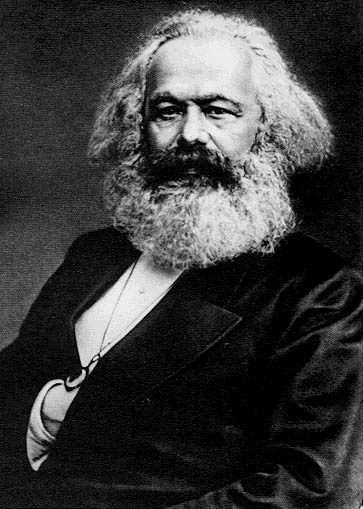
Karl Marx. So what if his ideologies caused the suffering and death of millions? He has a great big bushy beard.
Somehow the distinction between governmental and non-governmental classes is not deemed a paradox when the government is established by a Pop Idols style popularity contest called democracy. This also makes a socialist/communist system acceptable because the greedy money grabbers who make up the majority of the population voted what is to be done with rich people's money.
The paradox of enrichment
The paradox of enrichment is a phenomenon in population ecology whereby increasing the food supply of prey has the undesired effect of also increasing the food supply of its predators. This is because giving more resources to a certain kind of prey causes its numbers to increase, which also inadvertently results in more food and resources for its predators. The predator numbers may increase beyond control and they may even cause the extinction of the prey. Thus, making things more comfortable for prey does not necessarily equate to taking care of its best interests.
The paradox of pesticides
Suggest then that you are a rich bitch and you aren't too happy with being taxed towards the breadline in order to feed the mouths of the barely literate. The solution is obviously to cull the numbers of the 'prey'. You'd need some kind of pauper pesticide because that would get rid of the spongers and moochers, right?
The paradox of pesticides occurs when a pest is given a pesticide and its numbers dwindle, but this inadvertently causes a decrease in the food supply of its predators. Thus, a pesticide may actually increase the numbers of a given pest in the long run due to dwindling natural predator numbers.
Princes and paupers by means of analogy
Suggest that the Gini coefficient gives you an indication of how the predators are distinguished from the prey in your economic population (it's not a good indicator but it's the one in common use).
If you were a pauper, your solution would be to move this coefficient more towards a straight diagonal line. Yet this puts you in danger of inadvertently increasing the number of princes who could exploit the paupers, so you'd be at the mercy of the paradox of enrichment.
Suggest that you'd rather be a prince, then your solution would be to edge the line more towards the bulging side. Yet this may drop you in the clutches of the paradox of pesticides, as there are less paupers to exploit.
What does this tell us about human economics?
Both paradoxes are a result of a third party that is above the laws of both predator and prey but that serves as a kind of referee of the entire system. Thus, humans who administer pesticides or who protect prey are inadvertently causing an imbalance in the natural, optimal equilibrium. Throughout nature - and throughout even human society for as long as we are organic beings - there is but one general law:

One general law, leading to the advancement of all organic beings, namely, multiply, vary, let the strongest live and the weakest die. - Charles Darwin
Of course this argument only applies if it were true that the rich get rich at the expense of the poor, namely if the 'rich get richer while the poor get poorer' statement isn't complete crap. If you believe that this isn't complete crap, the paradox of enrichment and the paradox of pesticides trap you at an equilibrium somewhere in a scenario where rich people are rich and poor people are poor anyway.
It is thus futile to allow a third party that is independent to interfere with processes that do not affect it directly. Like they say: in the bacon and eggs equilibrium, the chicken is involved but the pig is committed.
This reminds me of the debate on the disgraced Media Tribunal, which is meant to be an independent statutory body (stop laughing, the South African government is really under the impression that it can appoint an independent statutory body) that has to take care of the predator-prey dynamics of a system where it is only involved, and not committed.
Whether government is happy about it or not, a self-regulatory system really is the best possible system for as long as we are organic beings. The only logical conclusion is that beer should be our currency.
12 September 2010
14 May 2010
What does the Gini coefficient mean?
The Gini coefficient is often cited by politicians and other socialists to highlight income inequalities. Usually, it is meant to invoke a moral judgement concerning income gaps, thereby justifying government intervention in the economy in a Keynesian manner. This is exactly where the Gini coefficient is abused for ulterior motives.
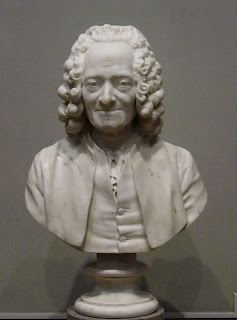
Whatever you do, crush the infamous thing, and love those who love you. - Voltaire, who rocks and not just because he is a bust.
The Gini coefficient is a measure of income inequality. There are two assumptions here with regards to income inequality, namely:
The Gini coefficient is obtained by plotting the Lorentz curve (representing actual income distribution) to the normal distribution line (representing the ideal income distribution where everyone receives the same amount of income).
This sounds confusing, but it isn't. The Gini coefficient is simply a measure of how far the actual income distribution is from the line of perfect income equality.
None whatsoever. The Gini coefficient simply states things as they are, even though its value may be distorted to suit your particularly malignant political purpose. The reason why I claim that there cannot be any moral scrutiny forthcoming from the Gini coefficient becomes apparent when one looks at the list of countries by income inequality.
The first observation is the slight difference between the UN figures and the CIA figures for the Gini index. The first 30 figures for the UN index have a median of 38, while the same first 30 figures for the CIA index have a median of 40,25. How is this possible? This discrepancy may be the result of the proportions of quantiles used to calculate the Gini coefficient.
Suggest that both the CIA and the UN had the same data sets. If the CIA used a lower granularity than the UN (in other words, less quantiles, or less squares on their grid), their Gini coefficient would usually be lower than the Gini coefficient of the UN. If you want to prove to your country that your economic policies are bringing about more income equality, you should use lower granularity.
Yet if the CIA used higher granularity than the UN (in other words more quantiles, or more squares on their grid), the Gini coefficient would typically be higher than that of the UN. If you were running a presidential campaign and you'd like to show your potential voters how the previous regime has failed, you could show them a Gini coefficient calculated with higher granularity.
Note that the same data set here could give widely different figures, while the actual income distribution has not changed one bit. This is why a Gini coefficient cited without describing the proportions of the quantiles used is a meaningless number that is better than a thumb suck number at a ratio of 1 to 0,999....
The second observation is less apparent, but it is obtained by comparing the Gini coefficients with the United Nations Human Development Index. Note that the Gini coefficient data I used here are from various years, while the Human Development Index data is from 2007. Regardless, there is no correlation between the level of human development and the Gini coefficient.
It becomes clear that the Gini coefficient is not a reliable measure to use when one is trying to give an impression of the current state of affairs of the general household in a given population. What then is the use of the Gini coefficient?
Having a state of affairs where a brain surgeon, a rocket scientist and a waiter all receive the same wage is not a desirable one. This is because transporting beverages does not really require the amount of mental strain, education, training and strong character that is required to obtain a PhD in physics or medicine.
Naturally, the opposite side of the spectrum, where one institute enjoys all the income while nobody else shares in the spoils of the gravy train is a kleptocracy. This is not a desirable state of affairs either. The safest road is usually in the middle. Intuitively, we deduce that a Gini index of around 0,5 is the most equal in that it is fair towards brain surgeons, rocket scientists and waiters, all things being equal.
Simon Kuznet discovered that - contrary to the interpretation often cited by hysterical politicians - a developing country often shows a decline in Gini coefficient index. This makes perfect sense because some people would start earning more while others would still earn the same, or less. This is a good sign, as it means development is taking place. Furthermore, Kuznet claims that the Gini coefficient reaches a maximum, after which the income inequality begins to decrease as more people work themselves into higher income groups.
Thus, citing a high Gini coefficient for a country like South Africa, and noting that it has increased since 1994, is actually good news as it shows that the country is developing. A high Gini coefficient could thus be good news or bad news, depending on the current level of development in the cited population. Once again we see that a Gini coefficient by itself is nothing but a number.
According to econometrics, the ideal Gini coefficient lies between 0,25 and 0,40. This is because at a level where brain surgeons, rocket scientists and waiters all receive the same wage, there is no financial incentive to study physics or neuroscience. Similarly, at levels where income inequality is too high, the ownership disputes and social incoherence affect development negatively. Private property and other human rights cannot be guaranteed to last where a government can decide to say, nationalise mines and disrupt productive farms after sniffing too many beer farts in a shebeen.
South Africa had a Gini index of 0,65 in 2005, according to the CIA. Instead of requiring the government to act to bring this Gini coefficient down for its own sake, it is perhaps a better idea to start focussing on the implications of such a high Gini coefficient, namely:
Next time you read a Gini coefficient thrown around like an absolute, simply enquire as to the granularity of the quantiles. If the author or speaker cannot answer you, chances are they read about a terribly high Gini coefficient on Wikipedia and are trying to create their own moral panic. It is imperative that a Gini coefficient be contextualised properly before it has any meaning whatsoever, as a number by itself is nothing but a number. A high Gini coefficient could be a very good thing, or a very bad thing, but it does not correlate with a desirable state of human development or with economic development.

Whatever you do, crush the infamous thing, and love those who love you. - Voltaire, who rocks and not just because he is a bust.
What is the Gini coefficient?
The Gini coefficient is a measure of income inequality. There are two assumptions here with regards to income inequality, namely:
- Complete income equality is when everyone receives an equal income. This state lies on one end of the scale and is represented by a Gini coefficient of 0.
- Complete income inequality is when one person or entity receives all income, while the rest receives none. This state lies on the opposite end of the scale and is represented by a Gini coefficient of 1.
The Gini coefficient is obtained by plotting the Lorentz curve (representing actual income distribution) to the normal distribution line (representing the ideal income distribution where everyone receives the same amount of income).
This sounds confusing, but it isn't. The Gini coefficient is simply a measure of how far the actual income distribution is from the line of perfect income equality.
What moral implications does the Gini coefficient have?
None whatsoever. The Gini coefficient simply states things as they are, even though its value may be distorted to suit your particularly malignant political purpose. The reason why I claim that there cannot be any moral scrutiny forthcoming from the Gini coefficient becomes apparent when one looks at the list of countries by income inequality.
Some deductions from the list of countries by income inequality
The first observation is the slight difference between the UN figures and the CIA figures for the Gini index. The first 30 figures for the UN index have a median of 38, while the same first 30 figures for the CIA index have a median of 40,25. How is this possible? This discrepancy may be the result of the proportions of quantiles used to calculate the Gini coefficient.
Suggest that both the CIA and the UN had the same data sets. If the CIA used a lower granularity than the UN (in other words, less quantiles, or less squares on their grid), their Gini coefficient would usually be lower than the Gini coefficient of the UN. If you want to prove to your country that your economic policies are bringing about more income equality, you should use lower granularity.
Yet if the CIA used higher granularity than the UN (in other words more quantiles, or more squares on their grid), the Gini coefficient would typically be higher than that of the UN. If you were running a presidential campaign and you'd like to show your potential voters how the previous regime has failed, you could show them a Gini coefficient calculated with higher granularity.
Note that the same data set here could give widely different figures, while the actual income distribution has not changed one bit. This is why a Gini coefficient cited without describing the proportions of the quantiles used is a meaningless number that is better than a thumb suck number at a ratio of 1 to 0,999....
The second observation is less apparent, but it is obtained by comparing the Gini coefficients with the United Nations Human Development Index. Note that the Gini coefficient data I used here are from various years, while the Human Development Index data is from 2007. Regardless, there is no correlation between the level of human development and the Gini coefficient.
It becomes clear that the Gini coefficient is not a reliable measure to use when one is trying to give an impression of the current state of affairs of the general household in a given population. What then is the use of the Gini coefficient?
What is the use of the Gini coefficient?
Having a state of affairs where a brain surgeon, a rocket scientist and a waiter all receive the same wage is not a desirable one. This is because transporting beverages does not really require the amount of mental strain, education, training and strong character that is required to obtain a PhD in physics or medicine.
Naturally, the opposite side of the spectrum, where one institute enjoys all the income while nobody else shares in the spoils of the gravy train is a kleptocracy. This is not a desirable state of affairs either. The safest road is usually in the middle. Intuitively, we deduce that a Gini index of around 0,5 is the most equal in that it is fair towards brain surgeons, rocket scientists and waiters, all things being equal.
Economic development and how it relates to the Gini coefficient
Simon Kuznet discovered that - contrary to the interpretation often cited by hysterical politicians - a developing country often shows a decline in Gini coefficient index. This makes perfect sense because some people would start earning more while others would still earn the same, or less. This is a good sign, as it means development is taking place. Furthermore, Kuznet claims that the Gini coefficient reaches a maximum, after which the income inequality begins to decrease as more people work themselves into higher income groups.
Thus, citing a high Gini coefficient for a country like South Africa, and noting that it has increased since 1994, is actually good news as it shows that the country is developing. A high Gini coefficient could thus be good news or bad news, depending on the current level of development in the cited population. Once again we see that a Gini coefficient by itself is nothing but a number.
What is the ideal Gini coefficient?
According to econometrics, the ideal Gini coefficient lies between 0,25 and 0,40. This is because at a level where brain surgeons, rocket scientists and waiters all receive the same wage, there is no financial incentive to study physics or neuroscience. Similarly, at levels where income inequality is too high, the ownership disputes and social incoherence affect development negatively. Private property and other human rights cannot be guaranteed to last where a government can decide to say, nationalise mines and disrupt productive farms after sniffing too many beer farts in a shebeen.
South Africa had a Gini index of 0,65 in 2005, according to the CIA. Instead of requiring the government to act to bring this Gini coefficient down for its own sake, it is perhaps a better idea to start focussing on the implications of such a high Gini coefficient, namely:
- Incentive traps: who gets the incentive from FIFA and Eskom's new power stations? Wouldn't it aid development - and by implication our high Gini coefficient - more positively if South Africa sidestepped the government in these matters entirely?
- Erosion of social cohesion: The ongoing genocide of white South Africans is still largely being ignored by the South African government and the media. Kill the Boer and other struggles against reality songs are not aiding in creating social cohesion in South Africa. The longer the government pussyfoots with dealing with these hate speech instances, the more murky the social cohesion becomes.
- Social conflicts: Black economic empowerment has failed because it is a racist employment policy. Getting rid of double standards such as BEE would go far further to bringing down the Gini coefficient of South Africa than more government intervention in the economy ever could.
- Uncertain property rights: South Africans should insist on unequivocal and very real support of its constitution by our government. There cannot even be a debate about nationalisation of our mines or land grabs Zimbabwe style because these matters bring about uncertainty about property rights. In return, those with resources are not going to invest in South Africa simply because their property rights here are uncertain. If there were certainty regarding property rights, the Gini coefficient would come down as more resources would flow into South Africa and more would stay here!
Conclusion
Next time you read a Gini coefficient thrown around like an absolute, simply enquire as to the granularity of the quantiles. If the author or speaker cannot answer you, chances are they read about a terribly high Gini coefficient on Wikipedia and are trying to create their own moral panic. It is imperative that a Gini coefficient be contextualised properly before it has any meaning whatsoever, as a number by itself is nothing but a number. A high Gini coefficient could be a very good thing, or a very bad thing, but it does not correlate with a desirable state of human development or with economic development.
Further reading
- The Wikipedia page on economic inequality.
- The Wikipedia page on the Gini coefficient.
- The Wikipedia page on Kuznet's curve, explaining why a Gini coefficient needs to be contextualised.
22 January 2009
What has the Dalai Lama ever done for you?
The Lama has no formal schooling in the fields of political science, diplomacy or international law. You ask the Lama why Tibet should be independent, and he can't give you any valid reason. He has a monastic education and holds what is roughly the equivalent of a doctorate in Buddhism. The best he can do is claim that according to the ethics of the Yellow Hat Sect, Tibet should be independent from China. China has the Seventeen Point Agreement for the Peaceful Liberation of Tibet. Liberation here referring to the liberation of Tibet from (British, Indian and other foreign) imperialist forces and thus returning to Chinese rule.
The popular belief is that China invaded a fully autonomous state in the fifties. However, there is much debate over the exact nature of the sovereignty of Tibet. Upon closer investigation, this commonly held belief seems short-sighted.
Technically Tibet has only made any attempt to claim independence from China between 1913 to 1959, and even then Tibet failed to negotiate independence from China (China has never accepted the complete independence of Tibet, only other "imperialist" nations have). In other words, Tibet has never been able to proclaim its independence from China through either diplomatic nor military means. Tibet has no legitimate reason to claim that its independence was threatened by a the big bad Chinese regime (because its independence never existed) and flying all over the world rallying support from Western countries is not improving its relationship with China - China being the only nation in a position to grant Tibet independence.
Tibet has been part of China from the Yuang dynasty (1271 – 1368). Viewed in this light, the period of 1913 - 1959, during which Tibet tried to claim independence, becomes immaterial. Certainly not material enough to use as a basis for sovereignty on any legal grounds.
Within the Asian continent, there are many independent states. Granted, the People's Republic of China is not always happy with this arrangement, but why isn't Tibet following a similar route? That seems reasonable to me, instead of the Oprah Winfrey cult of personality celebrity populist angle that the Dalai Lama is attempting. China does not care about the West and right now, the West needs China economically. The way to put pressure on China is not by shaking hands with the likes of Sarkozy, who is a populist scoundrel (also not that clear on the separation of the church and state himself).
Seems like the Lama is using the "enemies of my enemy are my friends" approach without really being concerned with whom he is dealing, as long as they don't like China. The Lama has not done a single thing that proves to me that he should enjoy respect. He's like PETA in that regard.
If Tibet deserves independence from China, then surely South Ossetia and Abkhazia deserve independence from Georgia too? Why isn't the West rallying behind their cause? They're in a far more clear-cut situation than Tibet, yet the West (America in particular) does not rally behind them when they try to claim their independence from Georgia, mainly because the Russians are. Oh, and South Ossetia and Abkhazia don't have a charming old man in a tunic shaking hands with world leaders rallying for their independence.
I hate the Dalai Lama because he appeals to people's emotions and spirituality and does not rely on reason to better the position of Tibet. He is nothing but a theocrat. If L Ron Hubbard declared Scientologists independent from the rest of the world, how seriously would you take him? Why does the Lama deserve better treatment?
If hate is a strong emotion to apply to someone you don't personally know, then surely the opposite emotion of love is just as strong to apply to someone you don't personally know. Seems to me that it is irrational to claim that the Lama is wise, kind and a spiritual leader worthy of our affection with his sage advice and guidance offered to us when he can't solve his own problems.

The 14th Dalai Lama, Tenzin Gyatzo, has been defending his outmoded theocratic system from the confounds of an Indian monastery and Oprah Winfrey's talk show couch.
That's all there is to him, really.

Prime minister of Russia, Vladimir Putin. Where do we begin?
Who would you rather have fighting for your independence?
The popular belief is that China invaded a fully autonomous state in the fifties. However, there is much debate over the exact nature of the sovereignty of Tibet. Upon closer investigation, this commonly held belief seems short-sighted.
Technically Tibet has only made any attempt to claim independence from China between 1913 to 1959, and even then Tibet failed to negotiate independence from China (China has never accepted the complete independence of Tibet, only other "imperialist" nations have). In other words, Tibet has never been able to proclaim its independence from China through either diplomatic nor military means. Tibet has no legitimate reason to claim that its independence was threatened by a the big bad Chinese regime (because its independence never existed) and flying all over the world rallying support from Western countries is not improving its relationship with China - China being the only nation in a position to grant Tibet independence.
Tibet has been part of China from the Yuang dynasty (1271 – 1368). Viewed in this light, the period of 1913 - 1959, during which Tibet tried to claim independence, becomes immaterial. Certainly not material enough to use as a basis for sovereignty on any legal grounds.
Within the Asian continent, there are many independent states. Granted, the People's Republic of China is not always happy with this arrangement, but why isn't Tibet following a similar route? That seems reasonable to me, instead of the Oprah Winfrey cult of personality celebrity populist angle that the Dalai Lama is attempting. China does not care about the West and right now, the West needs China economically. The way to put pressure on China is not by shaking hands with the likes of Sarkozy, who is a populist scoundrel (also not that clear on the separation of the church and state himself).
Seems like the Lama is using the "enemies of my enemy are my friends" approach without really being concerned with whom he is dealing, as long as they don't like China. The Lama has not done a single thing that proves to me that he should enjoy respect. He's like PETA in that regard.
If Tibet deserves independence from China, then surely South Ossetia and Abkhazia deserve independence from Georgia too? Why isn't the West rallying behind their cause? They're in a far more clear-cut situation than Tibet, yet the West (America in particular) does not rally behind them when they try to claim their independence from Georgia, mainly because the Russians are. Oh, and South Ossetia and Abkhazia don't have a charming old man in a tunic shaking hands with world leaders rallying for their independence.
I hate the Dalai Lama because he appeals to people's emotions and spirituality and does not rely on reason to better the position of Tibet. He is nothing but a theocrat. If L Ron Hubbard declared Scientologists independent from the rest of the world, how seriously would you take him? Why does the Lama deserve better treatment?
If hate is a strong emotion to apply to someone you don't personally know, then surely the opposite emotion of love is just as strong to apply to someone you don't personally know. Seems to me that it is irrational to claim that the Lama is wise, kind and a spiritual leader worthy of our affection with his sage advice and guidance offered to us when he can't solve his own problems.
Comparing the Dalai Lama with Vladimir Putin
The Dalai Lama

The 14th Dalai Lama, Tenzin Gyatzo, has been defending his outmoded theocratic system from the confounds of an Indian monastery and Oprah Winfrey's talk show couch.
- He appears to have eyesight problems.
- He gets CIA backing, because the Lama has never held a job in his life.
- He writes self-help books, aimed at disarming you from your most precious weapon - your mind.
- He is a fan of Marxism. Probably because he expects it to support bums like himself. Maybe the Lama should visit Cuba sometime?
- He has nothing whatsoever to do with the noble llama. A llama has practical use.
That's all there is to him, really.
Vladimir Putin

Prime minister of Russia, Vladimir Putin. Where do we begin?
- A former member of the KGB, Putin graduated from the International Law branch of the Law Department of the Leningrad State University in 1975. He wrote his final thesis on international law.
- Putin was actually elected as the president of Russia. Despite his KGB intelligence background (which may or may not jeopardise the legitimacy of his appointment), it is worth noting that Russian people actually voted for him. He does not claim to have some divine right to rule.
- Putin is a Judo champion.
- He can fly planes, shoot guns and rescue scared pansies from the gaping jaws of lions, tigers and bears.
Who would you rather have fighting for your independence?
08 July 2008
Babes and badasses: Review of Black Seeds of Vengeance by Nile

Conclusion
In terms of being badass, Nile is one of the most innovative technical death metal bands. Each track is characterised by sheer brutality or ingenuity. This is their second album and it is a bit fractal, but if you know Nile well it is still worth listening to get to know their roots. Plus you can never go wrong with Derek Roddy on drums.
Review
"Libation Unto the Shades Who Lurk in the Shadows of the Temple of Anhur" evokes ancient Egypt in the mind's eye. This track features an acoustic guitar, lusciously recorded with multiple microphones inside a stone chamber underneath the recording studio to capture real reverb.
Anhur was originally a foreign war deity, characterised by a robe and the four feathers in his head dress. Shu, the Egyptian concept of sky, also had four feathers in its head dress. Anhur also means sky bearer. It is thus not surprising that Anhur and Shu later became merged to form Anhur-Shu. No prizes for guessing where that name came from.

Anhur, as portrayed on this site.
In the time of the New Kingdom, Anhur became known as a saviour. This is because people viewed war as the source of their emancipation from human burden. Freedom and victory were seen as a direct result of war. If you consider economics as a kind of warfare, with capitalism as the source of freedom and victory achieved over the human burden, Ludwig von Mises can be seen as a saviour and the earthly embodiment of Anhur. Socialism can then be seen as largely concerned with sharing human burden instead of combating it. In this view, capitalism is regarded as the war against socialism, and socialism is regarded as human burden.
Socialism considered here refers to an economic system where the means of production are owned and controlled by the government. No private land ownership is allowed. A definition of communism is a system with the credo: From each according to his ability, to each according to his need. For the purpose of this discussion, no distinction is made between communism and socialism.
The definition of capitalism considered here refers to an economic system where the means of production and the distribution of goods are owned and controlled by private ownership. In such a system, the only exploitation could thus result from the private owners themselves. Laissez faire capitalism, with minimal or no state intervention, is the preferred definition for this discussion.
In such a system, to claim that any person who benefits from capitalism is exploiting someone else is as short-sighted and far fetched as claiming electricity is evil because people get electrocuted. Just like with electricity, the benefits of capitalism far outweigh the disadvantages, but don't take my word for it. Take the word of Ludwig von Mises for it.

Badass capitalist Ludwig von Mises. He should really be wearing four feathers in a head dress.
Economic calculation problem
Socialism leaves many unanswered questions. Ludwig von Mises identified some of these with his criticism of socialist economics. A few key concerns addressed by capitalism which are not adequetly dealt with by socialism include:
- comparing heterogeneous goods
- relating utility to capital and consumption of goods
- entrepreneurship needs a pay-off
- coherent planning for production without economic stimulus
- financial markets need a way to guide capital investment in order to avoid economic depression
Disadvantages of socialism
- Socialism has no objective way of comparing heterogeneous goods, never mind services. How many fish go into a haircut? How many potatoes are a fish worth? What about a house? How many fish would you need to catch in order to barter for a house? What if the house builder is vegetarian? Clearly, a barter system is not without its shortcomings. Perhaps this is why a currency developed in primitive societies in the first place.
- Marxist theory argues that labour content serves as a means to value goods (labour theory of value). This is absurd, as a plastic chew toy from China arguably has very little labour content if it were made in a factory with very low labour intensity. Similarly, in a rationing system, there is no objective way to rate the consumption of goods or the suitability of those goods. How do you rate consumer satisfaction if the consumer does not have the ability to choose with his money?
- Entrepreneurship needs a pay-off. It is widely accepted that entrepreneurship is crucial to economic development. If you follow the credo of from each according to his ability and to each according to his need, someone like Bill Gates would have no incentive to identify a window of opportunity in the market and then figure out a way to exploit it. Why should he, if he would get according to his need?
Nobody needs a company worth billions of dollars, except (ironically) the millions of starving people who rely on charity. It is thus not accurate to presume that the millions of starving people are getting exploited by Bill Gates and other capitalists. The truth is it is the other way around. Millions of starving people are exploiting the capitalists, because the capitalists are losing out whenever they make a donation to charity. Of course, if the millions of starving people could be trained to take part in the economy, that is to become capitalists themselves, it is a win win. They would be producers and consumers, instead of only being parasitic consumers.
As an aside, in terms of labour theory of value, how much would a million dollar cheque from Bill Gates really be worth? Thousands of people performed labour for that cheque. Is it really fair to give that labour away? - Coherent planning for production without any economic stimulus would rely on the expert opinion of a few who were appointed by the government to make sure everyone remains the lowest common denominator. You should really not catch more fish than what a potato is worth, despite the fact that you can't account for the weather, potato blight or low fish levels. In a socialist system, you can't even do the accounting for that.
- Financial markets need a way to guide capital investment in order to avoid economic depression. You can't view wealth as a pie that needs to be divided among everyone. Everyone did not help to bake that pie. Those who are not economically active need to find a way to become economically active. It is not true that you are entitled to a job or entitled to an amount of wealth. If you had a sack of potatoes stored and your community hits a drought, but you weren't actually allowed to store potatoes for yourself, would it be fair to share those potatoes at your expense?
Naturally, this is a very biased rant against the evils of communism. Let's just say I would rather live in my own house in Africa than in the government's house in the USSR. Speaking in terms of communism, if the Spice Girls sold more than 23 million records and Nile needs to sell 1 million records to make ends meet, then surely the Spice Girls should buy a shit load of Nile albums. Now in theory that's not a bad idea at all, but in practice, if you had a socialist system, where would that money ultimately originate? How would the Spice Girls sell 23 million records if each person can only afford to buy one album? Would a band like Nile even exist in such a system, where choice is so limited? What would the Spice Girls do with a million of the same album?

The Spice Girls. The Marxist labour theory of value dictates that since the Spice Girls can hardly play any instruments, and Nile can play their instruments at near virtuoso level in their genre, each Spice Girl has to buy about a million copies of Nile's Black Seeds of Vengeance. Don't worry, it makes no sense to me either.
You can get a more balanced account of the entire argument on the Wikipedia page of the economic calculation problem. If you really want to feel your brain get smaller, read the counter arguments and notice how piss poor they are. Especially with regards to the surprising accuracy of prediction markets and supposedly the empirical evidence they bring along with them. Oh yes, not to mention that the USSR could not sustain itself while Hong Kong is a decidedly more advanced place to live.
Clearly, Nile's music just makes me angry. The Egyptian flavours in their lyrics just remind me that socialism is trying to reinvent the wheel when we are already conceptualising time travelling.
William J.H. Boetscker's Ten Cannots (not so common sense)
- You cannot bring about prosperity by discouraging thrift.
- You cannot strengthen the weak by weakening the strong.
- You cannot help little men by tearing down big men.
- You cannot lift the wage earner by pulling down the wage payer.
- You cannot help the poor by destroying the rich.
- You cannot establish sound security on borrowed money.
- You cannot further the brotherhood of man by inciting class hatred.
- You cannot keep out of trouble by spending more than you earn.
- You cannot build character and courage by destroying men's initiative and independence.
- And you cannot help men permanently by doing for them what they can and should do for themselves.
Track listing
- Invocation of the Gate of Aat-Ankh-es-en-Amenti
- Black Seeds of Vengeance
- Defiling the Gates of Ishtar
- The Black Flame
- Libation Unto the Shades Who Lurk in the Shadows of the Temple of Anhur
- Masturbating the War God
- Multitude of Foes
- Chapter for Transforming into a Snake
- Nas Akhu Khan she en Asbiu
- To Dream of Ur
- The Nameless City of the Accursed
- Khetti Satha Shemsu
Personell
Mostafa Abd el Aziz: arghoul.
Aly et Maher el Helbney : respirations on "The Nameless City of the Accursed".
Mohammed el Hebney: additional chants on "Khetti Satha Shemsu".
Peter Hammoura: vocals, additional drums.
Derek Roddy: drums.
Karl Sanders: vocals, guitar.
Dallas Toler-Wade: vocals, guitar.
Rating

Subscribe to:
Posts (Atom)
-
 This is a bold claim by Perry Marshall, whose definitions of code and pattern I have used here. Note that Marshall is not a biologist, but a...
 -
Devildriver, those groove growlers from the embers of Coal Chamber, had a full tour booked to South Africa. In typical South African fashion...
-
 Since my last post, No Media Tribunal , over 500 followers have joined the fray to oppose the Media Tribunal . I didn't realise there we...
