Showing posts with label game theory. Show all posts

23 April 2017

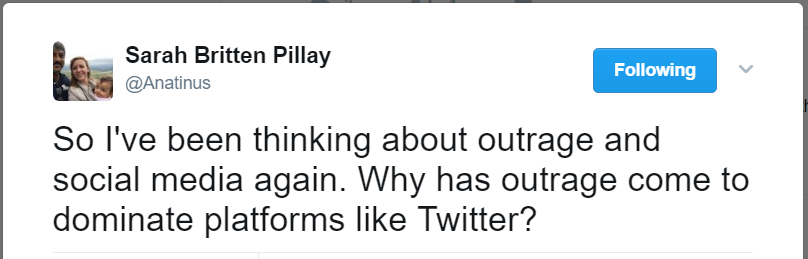
Why has outrage come to dominate platforms like Twitter?

This question was posted on twitter by Sarah Britten Pillay. I shall try to answer that here, or at least address some of the topics surrounding this notion.

What makes a platform like Twitter more outrageous than the next?

A brief summary of my thoughts on the topic:
  1. It would be interesting to contrive some outrage meter that could detect outrage levels in a piece of text.
  2. Plenty if not most of social media outrage is manufactured as a distraction.
  3. Outrage that isn't manufactured can be analysed by means of kin selection concepts from biology.
  4. If you aren't entirely sold on the sociobiology idea, then the balance of risk and incentive from game theory can also shed some light on the rationale behind social media outrage.

Outrage levels are too damn high

I do agree that social media platforms tend to be filled with more outrage than others, but as far as I know there is no means of detecting or measuring outrage. The need exists for some outrage quotient or some method of classifying platforms into categories according to their outrage content.

Intuitively, a platform like Twitter is more prone to outrage than a platform like Facebook, where your more close friends and family members are watching you in some perverse panopticon.


It is also intuitively more filled with outrage than Linked-In, because some employers might be loathe to hire people with free-flowing outrage. They much prefer hiring people with pent-up rage, those ticking time-bombs of the workplace, and people who confuse Linked-In for a dating platform.

If the assertion is that outrage dominates a platform, then there needs to be a gauge akin to the signal-to-noise ratio. Except here it would be a signal to outrage ratio, where outrage and signal are not necessarily mutually exclusive, but for the most part I think it's safe to regard outrage as just noise. White noise, even. In this manner, one could establish not only whether one platform is more outrageous than the next, but also whether outrage dominates a given platform.

I'm currently not drunk enough to math yet. Using a different approach, some chatbots can copy emotion. This approach can already help to classify a given piece of text in terms of emotional content, and by extension detect the presence of outrage. Perhaps even the level, then, when the amount of words associated with outrage as a ratio to neutral words or words related to the key concepts are considered. For the topic of this discussion, let's just assume that when it comes to outrage, Twitter has more of it than Facebook, and more of it than corporeal platforms like a coffee shop meeting or a braai gathering.

Plenty of outrage is manufactured - Fauxtrage, if you will

The recent Bell Pottinger white monopoly capital saga illustrates how this outrage is frequently intentionally engineered as bread and circuses distraction. The fact that it didn't work to add fuel to the fire of South Africa's perceived strained race relations, shows that outrage is frequently more bark than bite.

White monopoly capital. More real than the manufactured outrage campaign.
 

It also suggests that being numerate can help one to discern signal from noise, even in this medium. But being numerate is overkill. Purely sharpening critical thinking skills, with the aid of FiLCHeRS or PEARL, is sufficient to see when people are for example playing identity politics, or when there really is smoke to the fire. This counts especially for people like me who went to a tertiary institute suffering from the delusion that it will teach one critical thinking. It will not, unless you specifically take a course on critical thinking. It is far more likely to infect your mind with a particular ideology, like science must fall's peculiar notion of decolonising education. In other words, it doesn't teach you how to think, it rather teaches you what to think.

Bearing this in mind, plenty of the outrage on social media platforms can safely be assumed to be pure fabrication. As the public, we should hold the media to account, but it's more important to foster critical thinking skills so that inappropriate, context-free outrage has no fertile ground on which to fall.

What about real outrage?

No doubt there are some angry sociopaths out there hitching a ride next to the information superhighway. Why is this? Assuming that Facebook as a more personal and intimate platform contains less outrage than Twitter, and also less outrage than Linked-In, it points to two aspects:
  1. A more intimate platform has less outrage.
  2. A platform where outrage counts as a liability has less outrage.
This pattern seems to fit the perceived outrage of social media platforms in general. It can be analysed, though not sufficiently explained, by kin selection and Game Theory.

Hamilton's Rule: How kin selection emboldens outrage


Kin selection is the notion that traits detrimental to individuals in a given population would become more widespread if these traits increase the odds of survival for the entire population. In more crude terms, individuals would do silly things that prevent them from getting laid, if it means that their peers enjoy an increase in the odds of getting laid. If their shenanigans does work to get their peers laid, then this kind of savage behaviour can be expected to become more widely adopted. Enter the wingman.


Q: Mr Haldane, would you give your life to save your dying brother?
A: No, but I would give my life to save two brothers, or eight cousins.

What does this have to do with outrage? Of course genes don't get transferred in the biological sense here, but memes do spread in an analogous way. Certain groups treat activism as a commodity by means of the commodification of activism, whereby you virtue signal your sacrosanct virtues uncritically in order to be part of an in-group, and in order to cast aspersions with impunity onto any out-group that dares question these values. Try to tell someone that you're not a feminist, for example. Automatically, it means that you oppose gender equality. And if you are comfortable with the feminist religion, chances are someone has called you a feminazi.

By Todd Huffman from Phoenix, AZ - Lattice, CC BY 2.0, https://commons.wikimedia.org/w/index.php?curid=3365538
I like bees! Bee behaviour can be explained by kin selection.

As an internet troll on a platform where you have fewer close connections in your network, you then have incentive to be particularly incensed and make yourself unattractive to potential mates. This is purely because it is less risky to do so than on a platform where you have a more close-knit network.

Can Game Theory explain why someone would have a Britney Spears-level outrage meltdown on social media?

Game theory is the practice of analysing actions in terms of risk and reward pay-offs. The particular game form relevant here is the Volunteer's Dilemma. Similar to the kin selection notion, the Volunteer's Dilemma demands a sacrifice from one member of the group, which would be detrimental to that member, but which would gain a higher reward for the rest of the group.

It's completely rational not to be the poor sod handling the grenade, from an individual perspective. I deduce from this that on social media dominated by outrage, outrage must have a larger reward pay-off than it has risk. This despite the fact that knee-jerk outrage mongering could have one losing your job embarrassingly. 

Some groups attach value to anti-social displays. On a good day, this results in a kind of introspection and constructive criticism. On a bad day, these anti-social displays just make those displaying them look like troglodytes.

Conclusion

While there is no gauge of outrage as yet, it does appear that some social media platforms are more dominated by outrage than others. It is also important to reckon the manufactured, fake outrage out there and then perhaps stop taking outrage on social media seriously. It's not easy to discern between noise, outrage, real outrage, fake outrage, pure signal, and signal that is just abrasive or tactless.

Outrage itself is not necessarily a problem, since the platforms offer tools to deal with outrage. Some downsides of these tools are that they could lead to echo chambers and the loss of online anonymity. While we should hold the media to their own standards and point out their hypocrisy where we see it, the rest of us also have responsibility to sharpen our critical thinking skills.

By utilising kin selection concepts from biology and some risk-reward pay-off concepts from game theory, we can rationalise why people would seemingly go out of their way to huff and puff like firebrand revolutionaries on some social media platforms, while being meek and mild on other formats.

05 March 2011

Volunteer's Dilemma: Game Theory for Noobs

The Volunteer's Dilemma in Game Theory is best described by a corny mathematics joke.

A mathematician, an engineer and a chemist are at a conference. They are staying in adjoining rooms. One evening they are downstairs in the bar. The mathematician goes to bed first. The chemist goes next, followed a minute or two later by the engineer.

The chemist notices that in the corridor outside their rooms is a rubbish bin that is ablaze. There is a bucket of water nearby. The chemist starts concocting a means of generating carbon dioxide in order to create a makeshift extinguisher but before he can do so the engineer arrives, dumps the water on the fire and puts it out. The next morning the chemist and engineer tell the mathematician about the fire. She admits she saw it. They ask her why she didn't put it out. She replies contemptuously "there was a fire and a bucket of water: a solution obviously existed.


What's the deal with the Volunteer's Dilemma?


If nobody volunteers, the worst possible outcome is achieved.

It only takes one person to volunteer, but everyone sits around waiting for someone else to be the volunteer.

Elizabeth Hurley Liz Hurley Cannes Film Festival
Elizabeth Hurley who thankfully volunteered to star in a new television version of Wonder Woman as Veronica Cale.

06 February 2011

Chicken: Game Theory for Noobs

Chicken in game theory refers to a game where opponents are heading towards each other on a narrow road. The first opponent to chicken out loses, while if neither chicken out both end up losing their lives.

Ronald Reagan Mikhail Gorbachov Cold War discussions chicken brinkmanship game theory

Ronald Reagan and Mikhail Gorbachov having a staring contest.

Who is silly enough to play chicken?


Men, of course. Grown men. Chicken or brinkmanship is also used as a metaphor for contests where there is very little to gain and much to lose. It's basically the proverbial pissing contest or my dad is bigger than your dad, with bigger risks.

Many are of the opinion that an arms race is an example of chicken, though this is often not the case, as there may be more at stake than pure pride. During the Cold War, for example, the arms race was designed to bankrupt the Russian government, in addition to being a preventative measure against Russia's arms.

Game theory often analyses situations in terms of what could have been had different strategies been followed. In the case of an arms race, it is frequently the case that not having a considerable military capability leads to conflict. That is, not having weapons often leads one to be forced into conflict while having military capability often prevents conflict entirely. Like the saying goes, speak softly, but carry a big gun.

What is the optimal strategy for winning chicken?


The optimal strategy for winning chicken is not to play chicken at all. That is, to chicken out at any moment. With the game of chicken, if you chicken out you always win in the sense that you don't lose anything in real terms. If you don't chicken out, you only win if the opponent does chicken out.

Better to play games that are worth winning, like the lottery.

12 December 2010

Tragedy of the Commons: Game Theory for Noobs

The tragedy of the commons refers to a problem encountered when public resources are shared for private gain.
Commons here refers to a collective resource, which in its original context referred to a pasture for sheep.

Blaring it all out


The tragedy of the commons was first described by Hardin. Hardin observed a patch of green pasture surrounded by very barren land in North Africa. He investigated and found that the green pasture was privately owned land, while the surrounding barren nightmare was commonly held land, or commons.

sheep protestants catholics flock
A flock of sheep. Their behaviour is characterised by the donning of ceremonial Che Guevara t-shirts, a fondness for the band System of a Down and selective mind filters which only allow the writings of Karl Marx, Noam Chomsky, Jacques Derrida or Slavoj Žižek to leave its sediment inside their hive mind. My name is bleating heart liberal and I approve of this message.

The owner of the green patch in the centre had immediate incentive to protect his own land from devastation for his sheep. The surrounding barren land was commonly held, where individual sheep owners could let as many sheep loose as they could, without having an immediate incentive to take care of the commons. This means that they achieved a greater incentive from squeezing as many sheep as possible on the common lot (no Australian or New Zealander jokes, please). From their perspective, despite the No Free Lunch theorems, their sheep managed to get a free lunch.

The tragedy of the commons is a controversial topic, but it is valuable because it raises questions about environmental economics and how we are to deal with global warming.

Greed is good. Or is it?


As we've seen with the prisoner's dilemma, greed is good for you, in that particular context. This is because the incentive was greater while being selfish than what it was for being considerate and hopeful. When it comes to a commonly shared resource, like the commons, or the commonly owned coffee at the work canteen or water from the water cooler, being selfish and greedy is good for you in the immediate future but not so good in the long run.

Since the devastation of adding one more sheep does not immediately show, it is easy for individuals to always add one more sheep on a commons. Taking care of the resource is not explicitly your own problem so it implicitly becomes someone else's problem.

It is convenient to ignore the cumulative, long term effects of seemingly insignificant events, but once they accumulate and take their toll, the result is a depleted resource and massive sheep starvation. Or programmers without coffee. Trust me, code monkeys without coffee are far more devastating than sheep that can't graze.

Taxation: A tragedy of the commons scenario?


This makes me wonder about taxation. Taxation is similar to the commons that is supposedly to the benefit of everyone, but since nobody feels the cumulative effects of small tax increases immediately, it is always easy to hire one more minister, have one more department, or bail out one more bankrupt institute like General Motors or the SABC (as if going without television in South Africa would be a great loss to primate kind).

Small, private gains like flying your family around at the government's expense are easily dismissed as being negligible. Especially when compared with the intuitively worse effects of executive bonuses, even though they are few and far between and in reality have far less impact than a meagre wage increase for a few thousand workers, or a few hundred fat cats zipping around in private jets paid for by tax money.

It's easy to justify raising the taxes on the rich just a little to compensate for the Greater Good, while lowering the burden on the poor. Meanwhile, since some abstract like public interest takes care of the resource, each middle man in the loop can easily pass the hot potato of responsibility to the next middle man. Ensuring that public funds are handled responsibly becomes someone else's problem.

But small, seemingly negligible increases in taxation add up, as do small, seemingly negligible acts of corruption and incompetence. Once the straw has broken the camel's back, the sheep will be without a place to graze.

For a related topic, see Roznik's Utility Monster, which I should have included in my list of demons.

30 November 2010

Prisoner's Dilemma: Game Theory for Noobs

The Prisoner's Dilemma is a fairly famous scenario in game theory. The dilemma occurs when two alleged criminals are captured by the authorities. Both suspects are handled by some tough customers in their own holding cells, but the police do not have enough evidence to put either of them away for good just yet. In order for either of the suspects to go to jail for a significant time, the other has to deliver testimony. The authorities are stuck between a rock and a hard place, so they come up with a plea bargain.

Should you take the plea bargain?


The plea bargain gives each captured suspect a few options:
  • Deliver testimony while your partner keeps silent, get out of jail free and leave your partner rotting in jail for a full decade.

  • Both keep silent. If your partner doesn't spill the beans, this is the best scenario for both of you as the police wouldn't have enough on you to put either of you away for good, but both of you would spend 6 months in prison.

  • Spill the beans, have your partner spill the beans and share the decade between you. Both of you would thus spend 5 years imprisoned. Time to learn the harmonica and get used to orange jumpsuits.


Should you take the plea bargain, or hope that your partner in crime shuts up too?

Greed is good for you


It turns out that the best course of action is to cooperate with the police and leave your friend to maybe rot in jail. You might think that being selfish and greedy is bad and that you should consider other people's feelings. If you do think so, you are wrong in this case. Wrong because defecting from your partner and cooperating with the police is a dominant strategy. A dominant strategy is a strategy that is a clear winner, regardless of how you feel about it and what else you consider in your equation. Why is this?

To see why, it is often helpful to construct a normal form (or payoff matrix) representation of the strategy. This is the normal form of our prisoner's dilemma:

prisoners dilemma game theory payoff matrix normal form

I found the normal form of the prisoner's dilemma confusing, because it seems unnatural to me to label cooperation with the authorities as cooperation from the viewpoint of allegedly hardened criminals. Surely, cooperation should refer to honour amongst thieves and defection to cooperation with the authorities? Regardless, cooperation here means defaulting on your accomplice's friendship and signing whatever the police put in front of you. To defect means to keep your mouth shut least you sleep with the fishes.

To see why cooperation with the police is clearly dominant strategy, count the numbers for each player in each column. I have colour coded them for your benefit. Since most people would like to spend the least amount of time possible in prison, the column with the lowest number is the dominant strategy.

Danica McKellar model mathematics hot and smart

Unless of course you are lucky enough to get locked up with Danica McKellar and she could explain mathematics to you.

27 November 2010

Game Theory for Noobs

Game theory is not so much about Playstation as it is a science about strategy. The purpose of game theory is to determine the most rational course of action. Rational in this sense means the course of action that results in the highest amount of possible gain, or in the lowest amount of possible loss.

Christina Aguilera Christina Aquilera Hollywood Star
Christina Aguilera. She recently received her own Hollywood star. Not sure why, but it must mean she knows a thing or two about strategy.

John Nash is frequently associated with game theory. His tragic bout of schizophrenia is often abused to ridicule game theorists and to discredit the science of game theory, as is the case in the BBC documentary The Trap. However, John Nash was a fairly latecomer to the field as John von Neumann established the science in collaboration with Oskar Morgenstern with their book, Theory of Games and Economic Behaviour. This book reported a means to quantify the qualitative notions of expected utility, so in a way von Neumann and Morgenstern gave us mathematics for hope just like Bayes gave us the mathematics for faith with Bayesian analysis.

Nash Bridges
Nash Bridges. Not really relevant here.

The Nash equilibrium


Nash's contribution is the Nash equilibrium. Nash equilibrium results when all players involved know the strategies available to themselves and the other players, but no player has anything to gain by switching strategies. This appears superficially similar to the African philosophy of Ubuntu, which is an ethical concept based on the premise that “I am what I am because of who we all are”.

Thus, my strategies are limited by your strategies and your strategies are limited by my strategic choices, but neither of us have anything to gain by changing our current courses of action. If a Nash equilibrium is available, the most rational course of action is to cooperate and not to change your strategy. A Nash equilibrium is however not possible in all kinds of games. In these games, one can maximise gains by not cooperating (that is, by “cheating” or defaulting).

“Seven deadly sins, seven ways to win”


Strangely scientific lyrics from Iron Maiden in Moonchild. Seven of the games in which cheating or defaulting may be beneficial to you and detrimental - fatal, even - to other players as identified in Len Fisher's excellent book Rock, Paper, Scissors are:

  1. The Prisoner's Dilemma

  2. The Tragedy of the Commons

  3. The Free Rider Problem

  4. Chicken

  5. The Volunteer's Dilemma

  6. Battle of the Sexes

  7. Stag Hunt

In the next couple of posts, I shall deal with each of these and elaborate in my usual sombre tone.

Google sucks piles I'm moving to Steemit

Short and sweet, Google isn't allowing me to post ads on my blogs here on blogspot any longer. Not that I provide my angry nerd rants fo...