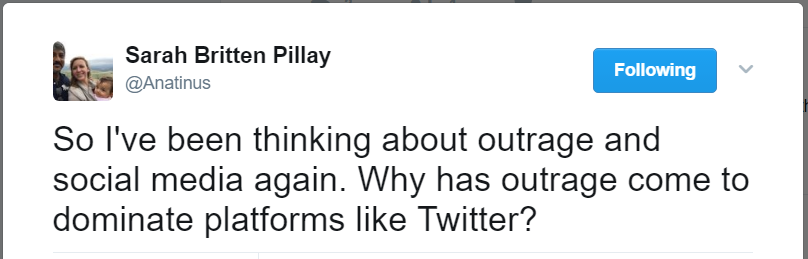
What makes a platform like Twitter more outrageous than the next?
A brief summary of my thoughts on the topic:
- It would be interesting to contrive some outrage meter that could detect outrage levels in a piece of text.
- Plenty if not most of social media outrage is manufactured as a distraction.
- Outrage that isn't manufactured can be analysed by means of kin selection concepts from biology.
- If you aren't entirely sold on the sociobiology idea, then the balance of risk and incentive from game theory can also shed some light on the rationale behind social media outrage.
Outrage levels are too damn high
I do agree that social media platforms tend to be filled with more outrage than others, but as far as I know there is no means of detecting or measuring outrage. The need exists for some outrage quotient or some method of classifying platforms into categories according to their outrage content.
Intuitively, a platform like Twitter is more prone to outrage than a platform like Facebook, where your more close friends and family members are watching you in some perverse panopticon.

Intuitively, a platform like Twitter is more prone to outrage than a platform like Facebook, where your more close friends and family members are watching you in some perverse panopticon.

It is also intuitively more filled with outrage than Linked-In, because some employers might be loathe to hire people with free-flowing outrage. They much prefer hiring people with pent-up rage, those ticking time-bombs of the workplace, and people who confuse Linked-In for a dating platform.
If the assertion is that outrage dominates a platform, then there needs to be a gauge akin to the signal-to-noise ratio. Except here it would be a signal to outrage ratio, where outrage and signal are not necessarily mutually exclusive, but for the most part I think it's safe to regard outrage as just noise. White noise, even. In this manner, one could establish not only whether one platform is more outrageous than the next, but also whether outrage dominates a given platform.
I'm currently not drunk enough to math yet. Using a different approach, some chatbots can copy emotion. This approach can already help to classify a given piece of text in terms of emotional content, and by extension detect the presence of outrage. Perhaps even the level, then, when the amount of words associated with outrage as a ratio to neutral words or words related to the key concepts are considered. For the topic of this discussion, let's just assume that when it comes to outrage, Twitter has more of it than Facebook, and more of it than corporeal platforms like a coffee shop meeting or a braai gathering.
Plenty of outrage is manufactured - Fauxtrage, if you will
The recent Bell Pottinger white monopoly capital saga illustrates how this outrage is frequently intentionally engineered as bread and circuses distraction. The fact that it didn't work to add fuel to the fire of South Africa's perceived strained race relations, shows that outrage is frequently more bark than bite.
 |
| White monopoly capital. More real than the manufactured outrage campaign. |
It also suggests that being numerate can help one to discern signal from noise, even in this medium. But being numerate is overkill. Purely sharpening critical thinking skills, with the aid of FiLCHeRS or PEARL, is sufficient to see when people are for example playing identity politics, or when there really is smoke to the fire. This counts especially for people like me who went to a tertiary institute suffering from the delusion that it will teach one critical thinking. It will not, unless you specifically take a course on critical thinking. It is far more likely to infect your mind with a particular ideology, like science must fall's peculiar notion of decolonising education. In other words, it doesn't teach you how to think, it rather teaches you what to think.
Bearing this in mind, plenty of the outrage on social media platforms can safely be assumed to be pure fabrication. As the public, we should hold the media to account, but it's more important to foster critical thinking skills so that inappropriate, context-free outrage has no fertile ground on which to fall.
What about real outrage?
No doubt there are some angry sociopaths out there hitching a ride next to the information superhighway. Why is this? Assuming that Facebook as a more personal and intimate platform contains less outrage than Twitter, and also less outrage than Linked-In, it points to two aspects:- A more intimate platform has less outrage.
- A platform where outrage counts as a liability has less outrage.
This pattern seems to fit the perceived outrage of social media platforms in general. It can be analysed, though not sufficiently explained, by kin selection and Game Theory.
Hamilton's Rule: How kin selection emboldens outrage

Kin selection is the notion that traits detrimental to individuals in a given population would become more widespread if these traits increase the odds of survival for the entire population. In more crude terms, individuals would do silly things that prevent them from getting laid, if it means that their peers enjoy an increase in the odds of getting laid. If their shenanigans does work to get their peers laid, then this kind of savage behaviour can be expected to become more widely adopted. Enter the wingman.

Q: Mr Haldane, would you give your life to save your dying brother?
A: No, but I would give my life to save two brothers, or eight cousins.
What does this have to do with outrage? Of course genes don't get transferred in the biological sense here, but memes do spread in an analogous way. Certain groups treat activism as a commodity by means of the commodification of activism, whereby you virtue signal your sacrosanct virtues uncritically in order to be part of an in-group, and in order to cast aspersions with impunity onto any out-group that dares question these values. Try to tell someone that you're not a feminist, for example. Automatically, it means that you oppose gender equality. And if you are comfortable with the feminist religion, chances are someone has called you a feminazi.
 |
| By Todd Huffman from Phoenix, AZ - Lattice, CC BY 2.0, https://commons.wikimedia.org/w/index.php?curid=3365538 I like bees! Bee behaviour can be explained by kin selection. |
As an internet troll on a platform where you have fewer close connections in your network, you then have incentive to be particularly incensed and make yourself unattractive to potential mates. This is purely because it is less risky to do so than on a platform where you have a more close-knit network.
Can Game Theory explain why someone would have a Britney Spears-level outrage meltdown on social media?
Game theory is the practice of analysing actions in terms of risk and reward pay-offs. The particular game form relevant here is the Volunteer's Dilemma. Similar to the kin selection notion, the Volunteer's Dilemma demands a sacrifice from one member of the group, which would be detrimental to that member, but which would gain a higher reward for the rest of the group.It's completely rational not to be the poor sod handling the grenade, from an individual perspective. I deduce from this that on social media dominated by outrage, outrage must have a larger reward pay-off than it has risk. This despite the fact that knee-jerk outrage mongering could have one losing your job embarrassingly.
Some groups attach value to anti-social displays. On a good day, this results in a kind of introspection and constructive criticism. On a bad day, these anti-social displays just make those displaying them look like troglodytes.
Conclusion
While there is no gauge of outrage as yet, it does appear that some social media platforms are more dominated by outrage than others. It is also important to reckon the manufactured, fake outrage out there and then perhaps stop taking outrage on social media seriously. It's not easy to discern between noise, outrage, real outrage, fake outrage, pure signal, and signal that is just abrasive or tactless.
Outrage itself is not necessarily a problem, since the platforms offer tools to deal with outrage. Some downsides of these tools are that they could lead to echo chambers and the loss of online anonymity. While we should hold the media to their own standards and point out their hypocrisy where we see it, the rest of us also have responsibility to sharpen our critical thinking skills.
By utilising kin selection concepts from biology and some risk-reward pay-off concepts from game theory, we can rationalise why people would seemingly go out of their way to huff and puff like firebrand revolutionaries on some social media platforms, while being meek and mild on other formats.


